USAID DEC
Leachability of metals from gold tailings by rainwater: an experimental and geochemical modelling approach
Sign inUNIVERSITY OF WITWATERSRAND
Leachability of metals from gold tailings by rainwater: an experimental and geochemical modelling approach
The Witwatersrand Basin in South Africa is home to gold tailings that contain elevated amounts of trace elements, which can potentially leach into surrounding soils and water systems.
2016 · 5 pages
Sign in to readA free account is required to download.
Abstract
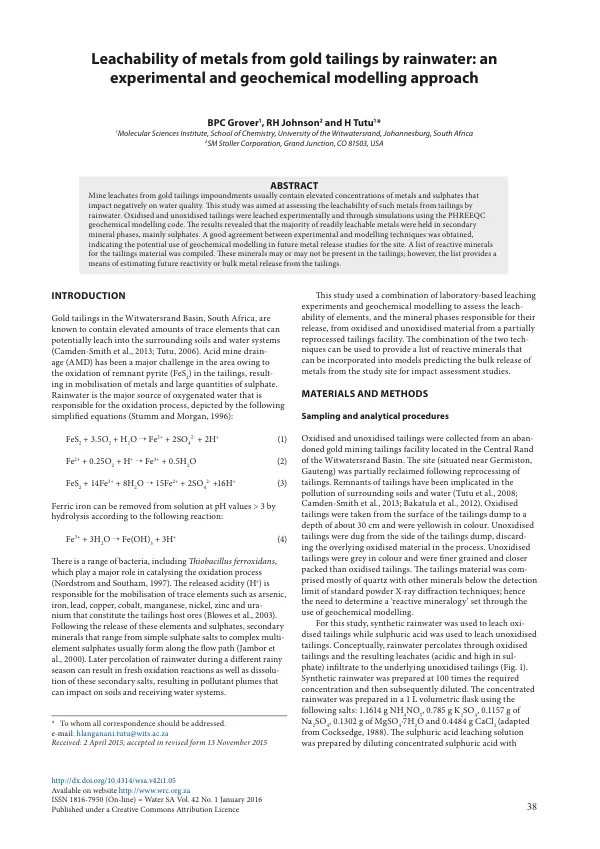
Acid mine drainage (AMD) has been a major challenge in the area due to the oxidation of remnant pyrite in the tailings, resulting in the mobilization of metals and large quantities of sulphate. Rainwater is the primary source of oxygenated water responsible for the oxidation process. The oxidation process involves the reaction of pyrite with oxygen and water to produce ferric iron, which can be removed from solution at pH values greater than 3 through hydrolysis. Bacteria, including Thiobacillus ferroxidans, play a significant role in catalyzing the oxidation process, releasing acidity that mobilizes trace elements such as arsenic, iron, lead, copper, cobalt, manganese, nickel, zinc, and uranium. Following the release of these elements and sulphates, secondary minerals form along the flow path, which can later dissolve and result in pollutant plumes impacting soils and receiving water systems. A study was conducted to assess the leachability of metals from gold tailings by rainwater using a combination of laboratory-based leaching experiments and geochemical modeling. Oxidised and unoxidised tailings were collected from an abandoned gold mining tailings facility in the Central Rand of the Witwatersrand Basin. The tailings material was comprised mostly of quartz with other minerals below the detection limit of standard powder X-ray diffraction techniques. Leaching experiments were conducted using a ratio of 20 g of tailings to 400 mL leaching solution, with synthetic rainwater used to leach oxidised tailings and sulphuric acid used to leach unoxidised tailings. The leachates were filtered and analyzed using inductively coupled plasma-optical emission spectroscopy (ICP-OES) and chemically suppressed ion chromatography (IC). The results revealed that the majority of readily leachable metals were held in secondary mineral phases, mainly sulphates. Geochemical modeling was used to establish speciation-solubility models using the PHREEQC version 3.2 geochemical modeling code. The Wateq4f database of the code was used, and data for the Al2(SO4)3∙6H2O mineral was imported from the LLNL database. Inverse modeling was undertaken to determine the mass transfer of minerals between the solutions, and forward modeling was used to validate the inverse models. The selection of minerals for inverse modeling requires knowledge of the mineralogy of the tailings in contact with the solution. The results of the study showed a good agreement between experimental and modeling techniques, indicating the potential use of geochemical modeling in future metal release studies for the site. A list of reactive minerals for the tailings material was compiled, which may or may not be present in the tailings but provides a means of estimating future reactivity or bulk metal release from the tailings. The study highlights the importance of understanding the leachability of metals from gold tailings and the potential impact on surrounding environments.
Related documents