USAID DEC
Leadership, Management, and Governance Project- National Malaria Control Program Capacity Building Project Trip Report
Sign inJHPIEGO
Leadership, Management, and Governance Project- National Malaria Control Program Capacity Building Project Trip Report
The Leadership, Management, and Governance Project-National Malaria Control Program Capacity Building Project aimed to build the capacity of local National Malaria Control Programs to effectively implement their national malaria strategies.
2015 · 7 pages
Sign in to readA free account is required to download.
Abstract
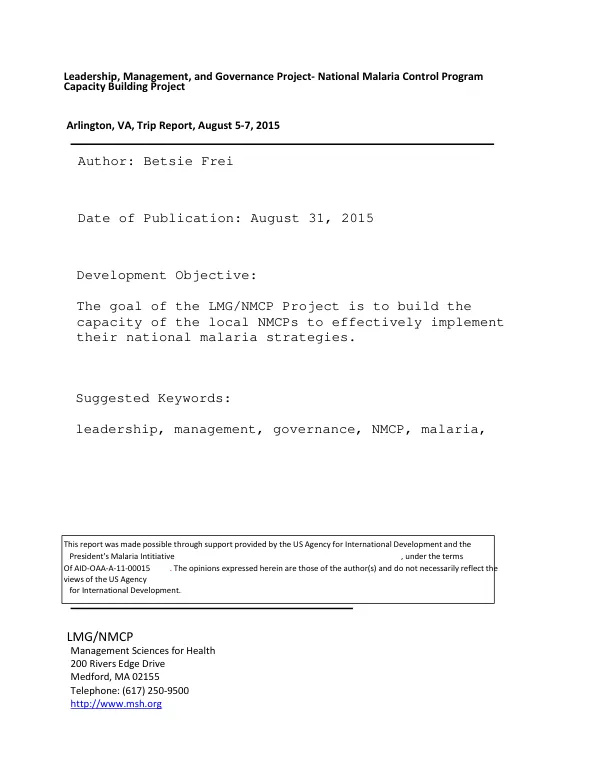
The project was funded by the US Agency for International Development and the President's Malaria Initiative, under the terms of AID-OAA-A-11-00015. The project's goal was to enhance the leadership, management, and governance of NMCPs, enabling them to effectively implement their national malaria strategies. To achieve this, the project focused on building the capacity of NMCPs to manage and coordinate malaria control efforts, improve their ability to track and report on malaria control outcomes, and enhance their capacity to manage and coordinate malaria commodity supply chains. The project's scope of work included coordinating monitoring, evaluation, and reporting for long-term technical assistance funded by the President's Malaria Initiative. The Senior Project Officer, Betsie Frei, was responsible for monitoring the progress of workplan implementation across several mechanisms, including LMG, SIAPS, and MCSP, and ensuring regular coordination among each project's Senior Technical Advisors who were embedded at NMCPs. During a trip to Arlington, Virginia, from August 5-7, 2015, Betsie Frei prepared for, coordinated, and facilitated the first quarterly coordination call with PMI, SIAPS, the LMG/NMCP advisors, and MCSP. She also continued to plan the monitoring, evaluation, and reporting for long-term technical assistance funded by the President's Malaria Initiative. The quarterly coordination call was attended by eight current advisors, who spoke about their role in supporting NMCPs, their successes, and their priorities for the current quarter. The call also discussed malaria outcome-level indicators that each mechanism can track to compare advisors' presences and work against the status of malaria control in the country. The next steps for the project included updating and submitting the quarterly summary sheet, updating the quarterly reporting template, sending invitations for the next coordination call, and continuing discussions regarding capacity building among and between advisors. The project also planned to finalize the logical and results frameworks and create an evaluation plan to measure the added-value of PMI-funded LTTA. Key individuals contacted during the trip included Emmanuel Le Perru, Monita Baba-Djara, Bhavna Patel, Seydou Doumbia, Jane Coleman, Erik Coulibaly, and Cheikh Gassama. These individuals were from various organizations, including MSH, USAID-PMI, SIAPS, and MCSP, and played important roles in the project's coordination and implementation.