USAID DEC
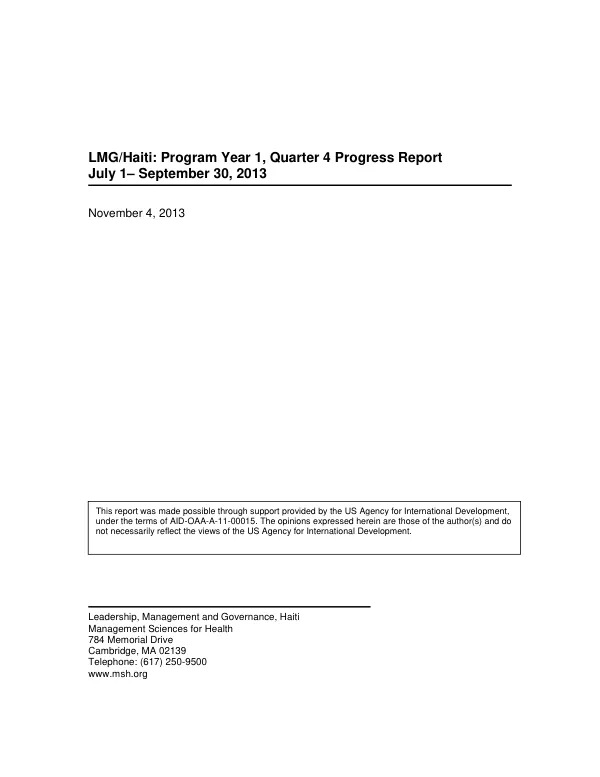
Leadership, Management and Sustainability Program in Haiti (LMS/Haiti) Quarterly Report: July –September 2013
Sign inMANAGEMENT SCIENCES FOR HEALTH
Leadership, Management and Sustainability Program in Haiti (LMS/Haiti) Quarterly Report: July –September 2013
The Leadership, Management and Sustainability Program in Haiti (LMS/Haiti) is a five-year initiative aimed at strengthening the leadership and management skills of Haiti's Ministry of Public Health and Population (MSPP) and other selected public and private sector partners.
2013 · 32 pages
Sign in to readA free account is required to download.
Abstract
The program's two objectives are to strengthen local capacity to manage the supply chain of USAID-donated condoms and family planning commodities, and to strengthen the capacity of the MSPP's Direction de la Pharmacie, du Médicament et de la Médecine Traditionnelle (DPM/MT) and Direction de la Santé de la Famille (DSF) to manage commodity logistics. During the fourth quarter of the fourth program year, LMS/Haiti continued to provide planned support to the MSPP and capacity building activities to strengthen the management of the USAID-donated condoms and family planning commodities supply chain. Supportive supervision visits were conducted at 7 United States Government (USG) sites in the Ouest department to validate commodity management data and family planning compliance. Additionally, 14 integrated supportive supervision visits were conducted with the Direction Sanitaire de la Grand Anse (DSGA), Direction Sanitaire du Centre (DSC), and Direction Sanitaire de Nord-Ouest (DSNO) to collect information on reproductive health commodity management and verify that stock keepers were trained on gestion logistique des intrants (GLI) and USG policy and legislative requirements for family planning. The program also continued uninterrupted, active distribution of family planning commodities and condoms to 240 USG sites. A total of 10,614,000 condoms, 293,200 vials of Depo-Provera, 159,900 cycles of Microgynon, 7,080 cycles of Microlut, 960 Jadelle implants, 50 intrauterine devices (IUD/Copper T), and 70 cycle beads were distributed to USG sites. Furthermore, 658,000 condoms, 32,900 vials of Depo-Provera, 200 Jadelle units, and 20,850 cycles of Microgynon were distributed to five Centres Départementaux d'Approvisionnement en Intrants (CDAIs) and one non-USG site of the MSPP. Training was also provided to 77 providers from the MSPP family planning unit on logistics using the national curriculum validated by the MSPP, and 55 providers from 48 health facilities obtained their certification on USG policy and legislative requirements for family planning. The national quantification workshop with the MSPP/DSF was conducted to forecast FP commodity needs for 2014-2015. The program's performance indicators during this reporting period show that LMS/Haiti has exceeded its target for the percentage of facilities that maintain acceptable storage conditions for the fourth quarter in a row. The program's achievements during this reporting period demonstrate its continued commitment to strengthening the leadership and management skills of the MSPP and other selected public and private sector partners, and to improving the management of the USAID-donated condoms and family planning commodities supply chain. The program's results during this reporting period include the following: 240 USG sites were fully supplied with condoms and contraceptives, and a total of 10,614,000 condoms, 293,200 vials of Depo-Provera, 159,900 cycles of Microgynon, 7,080 cycles of Microlut, 960 Jadelle implants, 50 intrauterine devices (IUD/Copper T), and 70 cycle beads were distributed to USG sites. Additionally, 658,000 condoms, 32,900 vials of Depo-Provera, 200 Jadelle units, and 20,850 cycles of Microgynon were distributed to five CDAIs and one non-USG site of the MSPP. The program's results during this reporting period demonstrate its continued commitment to improving the management of the USAID-donated condoms and family planning commodities supply chain, and to strengthening the leadership and management skills of the MSPP and other selected public and private sector partners. The program's achievements during this reporting period include the