USAID DEC
LEAF TECHNICAL GUIDANCE SERIES FOR THE DEVELOPMENT OF A FOREST CARBON MONITORING SYSTEM FOR REDD+
Sign inWINROCK INTERNATIONAL FOUNDATION
LEAF TECHNICAL GUIDANCE SERIES FOR THE DEVELOPMENT OF A FOREST CARBON MONITORING SYSTEM FOR REDD+
The LEAF Technical Guidance Series for the Development of a Forest Carbon Monitoring System for REDD+ provides a comprehensive framework for estimating carbon stocks and their uncertainty.
44 pages
Sign in to readA free account is required to download.
Abstract
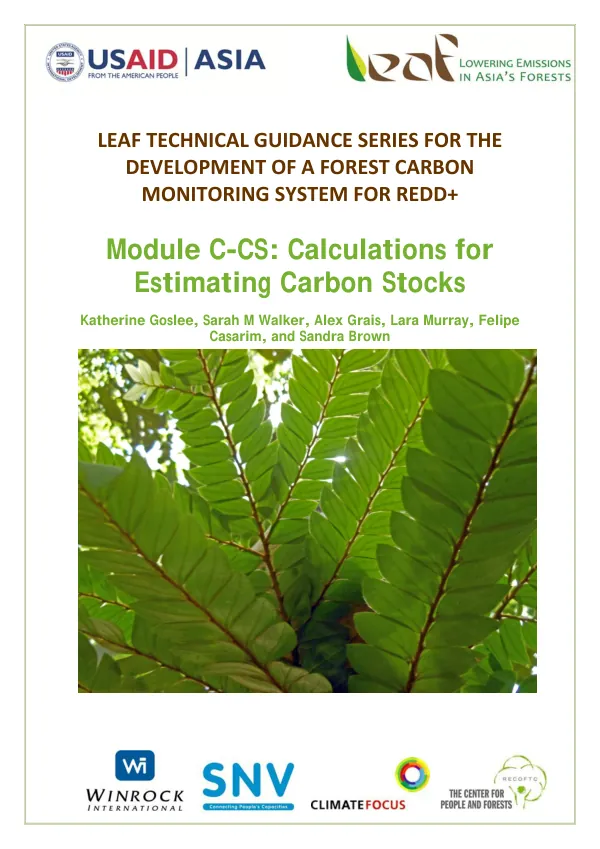
Module C-CS: Calculations for Estimating Carbon Stocks outlines the necessary calculations to convert field measurements into mean carbon stock estimates for various pools and to estimate net change in carbon stocks. The module is applicable for calculating carbon stocks using field data collected in accordance with Standard Operating Procedures developed by Walker et al. (2012). The required inputs include all field data, plot size(s), necessary allometric equations and/or ratios, and uncertainty requirements. Each section on individual calculations includes a specific list of required inputs to conduct those calculations. The estimation of carbon stocks is based on sampling a population of interest, such as one forest stratum, rather than taking measurements of the entire population. The purpose of sampling is to achieve a representative data set of the population in as efficient a manner as possible. Data collected through sampling can be used to infer information about the population through a set of descriptive statistics, which typically includes a measure of central tendency and an estimate of the variability of this measure. The arithmetic mean (mean) is the average value of the sampled observations and provides a measure of central tendency. The standard deviation provides a measurement of variation from the average value, and is calculated as the square root of the variance. The standard error provides the standard deviation of the mean and is estimated by dividing the standard deviation by the square root of the number of observations. The confidence interval gives the estimated range of values likely to include an unknown population parameter at the chosen confidence level. Uncertainty is a key metric to portray the confidence in calculations and an uncertainty assessment quantifies the variability of estimates, based on accuracy and/or precision of measurements. Uncertainty can be expressed using the confidence interval as a percent of the mean. The module provides guidance on calculation of the following components of data analysis: statistical measures, plot analysis, carbon stocks, wood products, total stocks and total uncertainty, destructive sampling, and change in tree carbon stocks over time. The calculations include live tree carbon stocks, standing dead wood carbon stocks, lying dead wood carbon stocks, clip plots, saplings, soil carbon stocks, and wood products. The module also provides guidance on uncertainty propagation, which is essential for REDD+ accounting under IPCC, UNFCCC, and all major greenhouse gas standards and registries. The uncertainty assessment quantifies the variability of estimates, based on accuracy and/or precision of measurements, and is commonly represented as a percentage. The acceptable level of uncertainty is often defined, and uncertainty can be expressed using the confidence interval as a percent of the mean. The module provides a comprehensive framework for estimating carbon stocks and their uncertainty, and is essential for REDD+ accounting and greenhouse gas standards and registries. The guidance on calculation of carbon stocks and uncertainty propagation will enable users to achieve a specified target of uncertainty, such as less than 15% of the mean at a 95% confidence interval.
Related documents