MANAGEMENT SCIENCES FOR HEALTH
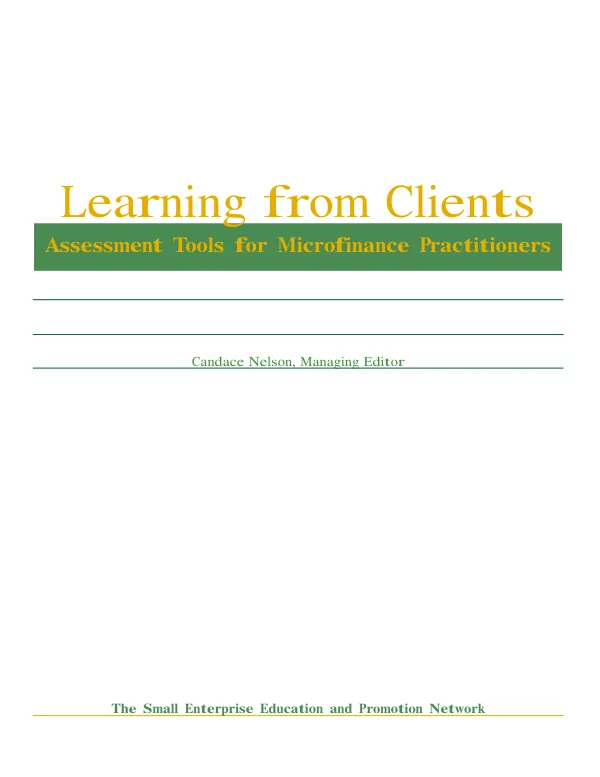
Learning from Clients: Assessment Tools for Microfinance Practitioners
The Small Enterprise Education and Promotion Network (SEEP) has developed a manual titled "Learning from Clients: Assessment Tools for Microfinance Practitioners" to help practitioners assess their clients.
341 pages
Sign in to readA free account is required to download.
Abstract
The manual is a result of a collaborative effort between the SEEP Network, the Assessing the Impact of Microenterprise Services (AIMS) Project, and USAID. The AIMS Project was initially a minority voice defending the value of impact assessment in microfinance, but over time, there has been a marked shift in attention to and interest in understanding the actual impact that microfinance programs are having on clients. The manual contains a set of five assessment tools that practitioners can use to gather information about their programs. These tools are designed to be practical, detailed, and step-by-step, providing guidance on planning and implementing impact assessments, analyzing data, and using the results to improve program products and services. The tools are intended to fill a gap in the middle ground between large-scale, rigorous, and costly impact assessments and low-cost, methodologically weak assessments. The five assessment tools included in the manual are: 1. Impact Survey: This tool is designed to assess the impact of microfinance programs on clients. It includes indicators and hypotheses related to client outcomes, such as income, savings, and loan repayment rates. 2. Client Exit Survey: This tool is used to gather information from clients who have exited a microfinance program. It includes questions related to client satisfaction, loan repayment rates, and overall program experience. 3. Use of Loans, Profits, and Savings Over Time: This tool is designed to track changes in client behavior and outcomes over time. It includes indicators related to loan usage, savings rates, and income levels. 4. Client Satisfaction: This tool is used to assess client satisfaction with microfinance programs. It includes questions related to program features, loan terms, and overall satisfaction. 5. Client Empowerment: This tool is designed to assess the level of empowerment among microfinance clients. It includes indicators related to client decision-making, financial management, and overall well-being. The manual also includes step-by-step instructions for using the tools, starting with initial preparations and ending with data analysis. The instructions provide guidance on planning and implementing impact assessments, analyzing data, and using the results to improve program products and services. The development of the manual involved a lengthy and in-depth process of consultation and field testing, reflection, and improvement. The process was led by a core team of SEEP Network private voluntary organization (PVO) practitioners, supplemented by the guidance of AIMS researchers and USAID, and engaged nongovernmental organizations (NGO) practitioners of microfinance in six sites around the world as testers, trainees, and early users. The manual has already shown that it serves as a template to be adapted, and the authors welcome new versions of the tools, as well as recommendations for improvement. The manual is expected to accelerate learning about impact assessment in the microfinance field, leading to greater insight about the outcomes of microenterprise development as practiced today, as well as how to improve it.
Related documents