MANAGEMENT SYSTEMS INTERNATIONAL
Religious and Ethnic Minority Health Needs Assessment Briefing Note: Lebanon
The Religious and Ethnic Minorities Health Needs Assessment in Lebanon highlights the significant health challenges faced by the country's religious and ethnic minority populations.
2021 · 3 pages
Sign in to readA free account is required to download.
Abstract
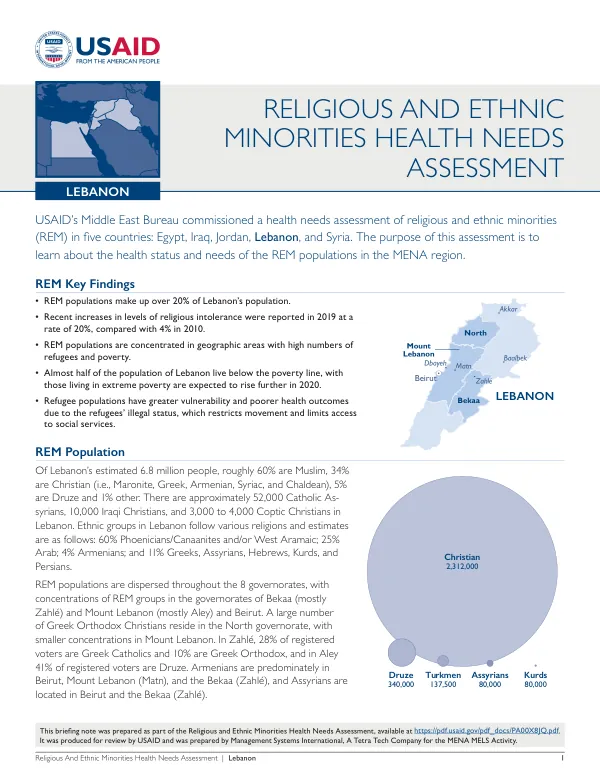
These populations make up over 20% of Lebanon's population, with the majority being Christian, Druze, and Assyrian. The assessment reveals that recent increases in levels of religious intolerance have been reported, with a 20% increase in 2019 compared to 4% in 2010. The assessment notes that REM populations are concentrated in geographic areas with high numbers of refugees and poverty. Almost half of the population of Lebanon lives below the poverty line, with those living in extreme poverty expected to rise further in 2020. Refugee populations have greater vulnerability and poorer health outcomes due to their illegal status, which restricts movement and limits access to social services. The assessment also highlights the significant health system challenges faced by Lebanon, including a lack of health workforce, particularly family care physicians and nurses, and mental health professionals. The country's healthcare system has a surplus of specialists, but it suffers from a critical shortage of competent family care physicians and nurses, and mental health professionals. Significant staff shortages are reported in areas with high concentrations of REM populations, such as Bekaa. The assessment notes that the COVID-19 pandemic has accelerated the country's economic decline, with over 80% of respondents having lost their main source of income due to the lockdown. The pandemic has also led to a shortage of hard currency, resulting in only 10% of the country's medical needs being imported. The outbreak has decreased the nurse-to-patient ratio from 1 for every 20 to 1 for every 12 patients, and nurses have suffered a 50% salary reduction. The assessment highlights the inadequate mental health service availability, accessibility, and affordability in Lebanon. Mental health care is poorly integrated into primary care, and there is a critical shortage of mental health professionals, with a reported 3 per 100,000 individuals. This deficiency, coupled with high levels of associated stigma, has contributed to the underdiagnosis of mental health conditions. Severe shortages of mental health services are reported in Bekaa, where REM populations are concentrated. The assessment also notes that public health care is underfunded and private health care is unregulated and increasingly unaffordable. Low utilization of primary care and high rates of care-seeking for curative services have led to high levels of health spending on hospital-based curative care. Significant out-of-pocket expenditures have resulted in 50% of vulnerable host communities and 70% of Syrian refugees reporting that health care was unaffordable and inaccessible. The assessment concludes that the Syrian crisis and the economic collapse have put tremendous pressure on the health care system in Lebanon. The country receives significant donor funding, but it is not enough to address the current crisis. Most primary healthcare centers are operated by NGOs, which rely heavily on donor funding and regularly face funding shortages. The assessment highlights the need for a comprehensive health system reform in Lebanon, including increasing funding for public health care, improving the availability and accessibility of mental health services, and addressing the shortage of health workforce. The assessment also emphasizes the need for a coordinated response to the health needs of REM populations, including refugees and vulnerable host communities.
Related documents