USAID DEC
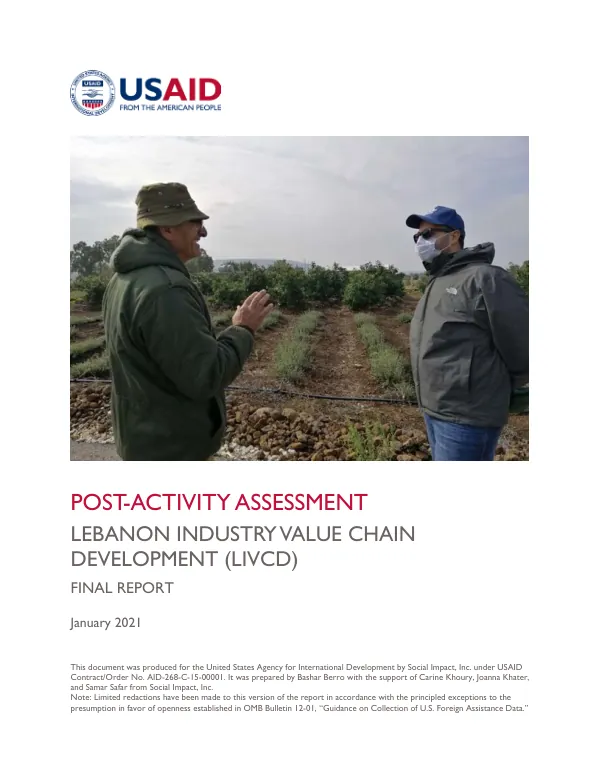
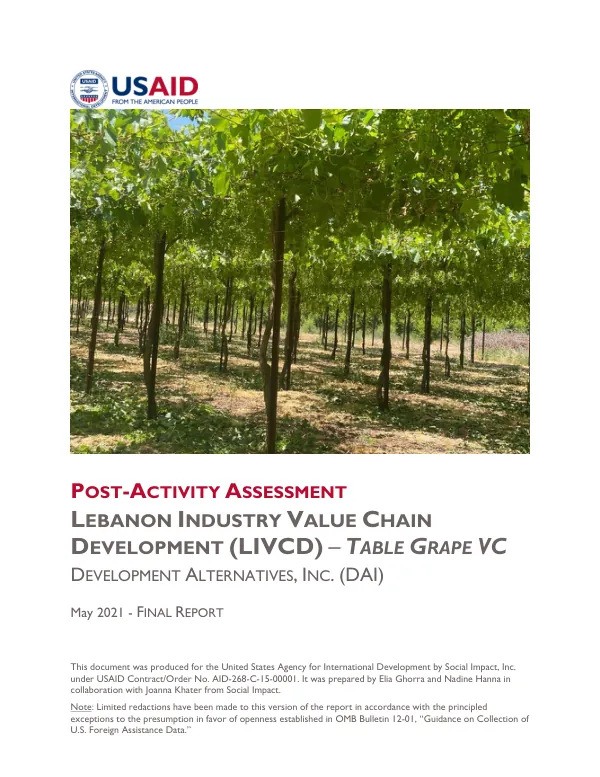
Post-Activity Assessment of the Table Grapes' Value Chain Interventions Financed Under the USAID/LIVCD Project
Sign inDEVELOPMENT ALTERNATIVES, INC./FINNET
Post-Activity Assessment of the Table Grapes' Value Chain Interventions Financed Under the USAID/LIVCD Project
The Lebanon Industry Value Chain Development (LIVCD) project was a $42-million program implemented by Development Alternatives, Inc.
2021 · 22 pages
Sign in to readA free account is required to download.
Abstract
(DAI) between September 2012 and January 2019. It aimed at developing inclusive and competitive value chains (VCs) in rural areas to help increase the local population's income. The project was subject to a mid-term review in November 2016 and to a final performance evaluation upon its completion in January 2019. The table grape VC was one of eight VCs supported by LIVCD. The activities implemented included the provision of technical assistance (TA), equipment, and grants. The main objective of LIVCD's grape component was to encourage the implementation of new and improved varieties of table grapes and to support the farmers throughout the VC, from production to harvesting to post-harvest activities, with the ultimate aim of boosting the export of Lebanese grapes to European and Gulf Cooperation Council (GCC) countries. The interventions were done in a way to reinforce the vertical integration of small and medium farmers in the table grape VC, linking them to input suppliers and service providers as well as traders and exporters. To achieve this objective, LIVCD offered several farmers in the Beqaa governorate training, TA, agricultural equipment, and linkages with various stakeholders. In addition, the project provided grants to the following two grape exporters to help farmers invest in new grape varieties desired in international markets: Middle East Business Company (MEBC) and another exporter. According to the Economic Impact Assessment conducted by DAI in May 2018, MEBC worked with 18 beneficiary farmers, helping them to plant new varieties of grapes (especially Red Globe). MEBC's cooperation with LIVCD resulted in planting around 231 dunums of land through co-investment. The assessment team conducted interviews with LIVCD's beneficiaries and two main partners in the table grape VC in addition to field visits to the financed vineyards. They looked at the facilities' functionality and the beneficiaries' capacity to properly maintain their vineyards, become self-reliant, and achieve sustainable results. The assessment team evaluated the level of compliance of LIVCD's activities and outcomes within the table grape VC with the objectives and indicators initially set. The evaluation was based on three main pillars: relevance, efficiency and effectiveness, and sustainability. The assessment found that the interventions implemented by LIVCD had a positive impact on the farmers' economic gains, with a significant increase in the production and quality of table grapes. The linkages created between exporters and farmers also had a positive impact on the selling/export channels adopted by the farmers. The assessment team also looked at the sustainability of the linkages created between exporters and farmers. They found that the linkages were viable and had a positive impact on the farmers' ability to maintain their operations financially. The assessment team also found that the farmers were able to properly maintain their vineyards and achieve sustainable results. The assessment team concluded that the LIVCD project had a positive impact on the table grape VC in Lebanon, and that the interventions implemented by the project had a lasting impact on the farmers' economic gains and the linkages created between exporters and farmers. The assessment team provided a set of recommendations to be considered by USAID and/or other donors or agencies wishing to invest in Lebanon's agricultural sector, especially in the table grape VC. The recommendations included continuing to support the development of inclusive and competitive value chains in rural areas, and providing technical assistance and grants to farmers to help them invest in new grape varieties desired in international markets. The assessment team also recommended that future projects and programs should focus on building the capacity of farmers to properly maintain their vineyards and achieve sustainable results.