SOCIAL IMPACT, INC.
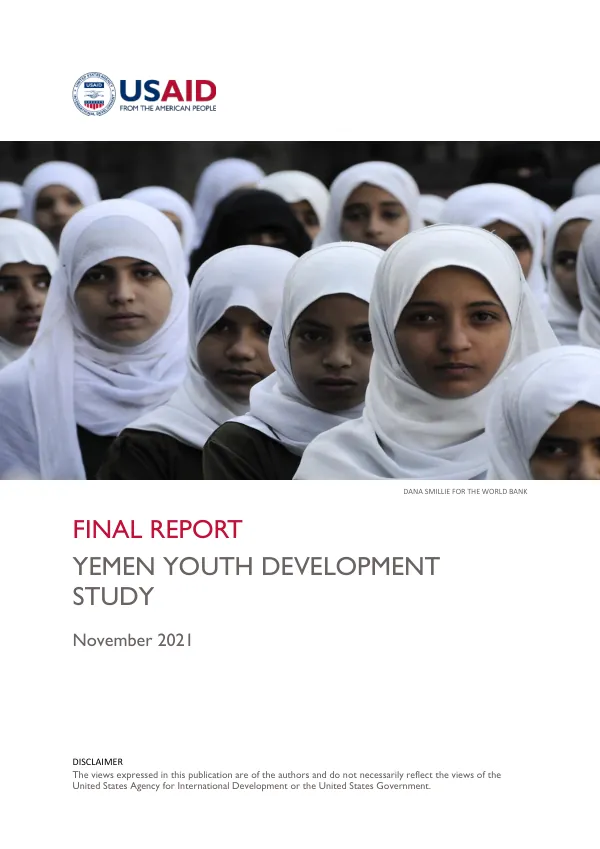
Yemen Youth Development Study – Final Report
The Yemen Youth Development Study was designed to support the U.S.
2021 · 148 pages
Sign in to readA free account is required to download.
Abstract
Agency for International Development's (USAID) update to the Yemen country strategy, known as the Yemen Programming Approach (YPA). The study aimed to explore the challenges, priorities, and opportunities faced by Yemeni youth in relation to the five YPA sectors: health, education, water, sanitation, and hygiene, economic recovery, livelihoods, and agriculture, and governance, peace, and stability. The study was conducted in two phases. Phase 1 involved a structured literature review of 28 documents, telephone interviews with 22 youth and 11 non-youth key informants, and a brief web-based survey administered to 17 individuals. Phase 2 expanded the scale of youth participation, with the evaluation team interviewing 135 persons. The study found that Yemeni youth face significant challenges, including limited access to quality education and healthcare, high levels of unemployment, and limited economic opportunities. The study also identified opportunities for youth development, including the potential for youth to contribute to the rebuilding and development of Yemen. The study's findings suggest that there are programmatic gaps and cross-sector connections in the youth development sector in Yemen. The study recommends integrating youth development policies and approaches into USAID activity design to enable Yemeni youth to contribute to the rebuilding and development of Yemen. The study also identified development partners, implementing partners, government bodies, and local organizations that serve youth in Yemen. The study found that these organizations use various models and approaches, including the Youth Programming Approach (YPA), which aims to promote positive youth development. The study's findings are intended to inform the integration of youth programming principles into the YPA extension and possibly into future activity design. The study's recommendations aim to support the development of effective youth development policies and approaches in Yemen. The study's methodology involved a structured literature review, telephone interviews, and a web-based survey. The study's findings are based on data collected from 135 persons across two study phases. The study's recommendations are intended to support the development of effective youth development policies and approaches in Yemen. The study's findings suggest that there are opportunities for youth development in Yemen, including the potential for youth to contribute to the rebuilding and development of Yemen. The study recommends integrating youth development policies and approaches into USAID activity design to support the development of effective youth development programs in Yemen. The study's recommendations aim to support the development of effective youth development policies and approaches in Yemen. The study's findings are intended to inform the integration of youth programming principles into the YPA extension and possibly into future activity design. The study's methodology involved a structured literature review, telephone interviews, and a web-based survey.
Related documents