TETRA TECH ARD, INC.
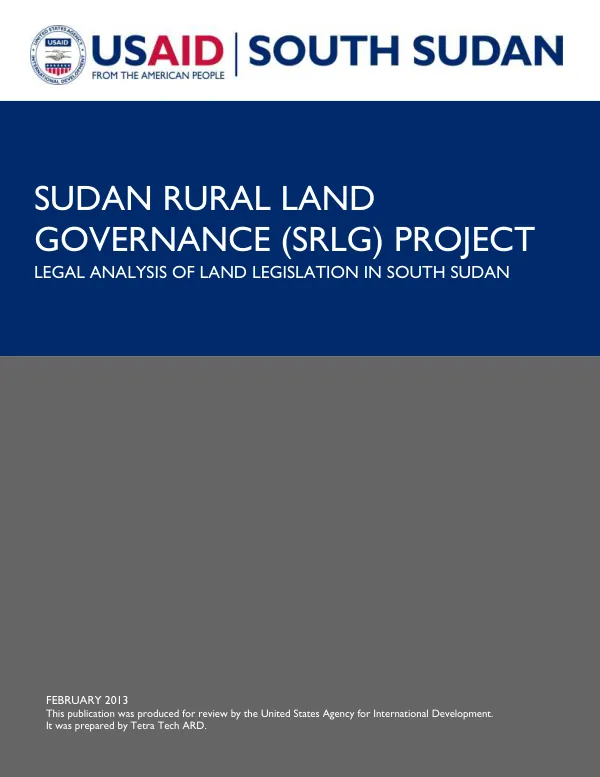
Legal Analysis of Land Legislation of South Sudan
The South Sudan Rural Land Governance (SRLG) Project conducted a legal analysis of land legislation in South Sudan.
2013 · 37 pages
Sign in to readA free account is required to download.
Abstract
The project aimed to strengthen the legal framework governing land tenure and property rights in the country. The analysis focused on the Draft Land Policy and other relevant legislation, including the Land Act, Constitution, Local Government Act, Investment Promotion Act, and Draft Land Act Regulations. The Draft Land Policy provides guidance on eleven thematic land tenure and property rights topics. The policy emphasizes the importance of tenure security, which protects against arbitrary loss of land rights and requires fair and just compensation for land taken for public purposes. The policy also endorses three types of tenure systems: public, community, and private. The Land Act defines the three types of tenure systems, but the definitions are inconsistent with Article 171 of the Constitution. The Constitution defines public land, community land, and private land, but the Land Act uses the term "customary" instead of "community" to describe community land. The SRLG legal expert recommended that the definition of community land in the Constitution should incorporate the attributes listed in the Land Act. Public land is defined with sufficient clarity and detail in Section 10 of the Land Act. However, the definition provided in Article 171 of the Constitution contains only two attributes, which undermines the validity of the definition in the Land Act. The SRLG legal expert recommended that the definition in the Constitution should be revised to incorporate the attributes listed in the Land Act. The Land Act also provides definitions for community land, which includes land lawfully registered in the name of group representatives, land held, managed, or used by specific communities, and land transferred to a specific community by any process of law. The SRLG legal expert recommended that the definition of community land should be revised to clarify the rights and responsibilities of community landholders. The SRLG project also analyzed the roles of land administration bodies, including national and state land administration bodies, local land administration bodies, and community land administration bodies. The project identified gaps and contradictions between the laws themselves and with the Land Policy. The recommendations provided by the SRLG project aim to strengthen the legal framework governing land tenure and property rights in South Sudan. The project's recommendations include revising the definition of community land in the Constitution to incorporate the attributes listed in the Land Act, clarifying the rights and responsibilities of community landholders, and revising the definition of public land in the Constitution to incorporate the attributes listed in the Land Act. The project also recommended that the Land Act should be revised to provide clear definitions of the three types of tenure systems and the rights conveyed under each. The SRLG project's legal analysis of land legislation in South Sudan provides a comprehensive and targeted reference resource to assist the South Sudan Land Commission in prioritizing its legislative initiatives to strengthen the legal framework governing land tenure and property rights in the country. The project's recommendations aim to promote security of tenure, protect against arbitrary loss of land rights, and ensure fair and just compensation for land taken for public purposes.