TETRA TECH
Gender, Youth, and Land Tenure: Lessons from Zambézia, Mozambique
The Integrated Land and Resource Governance (ILRG) program, funded by the United States Agency for International Development (USAID), aims to improve land tenure security for women and youth as part of broad-based economic empowerment.
2021 · 4 pages
Sign in to readA free account is required to download.
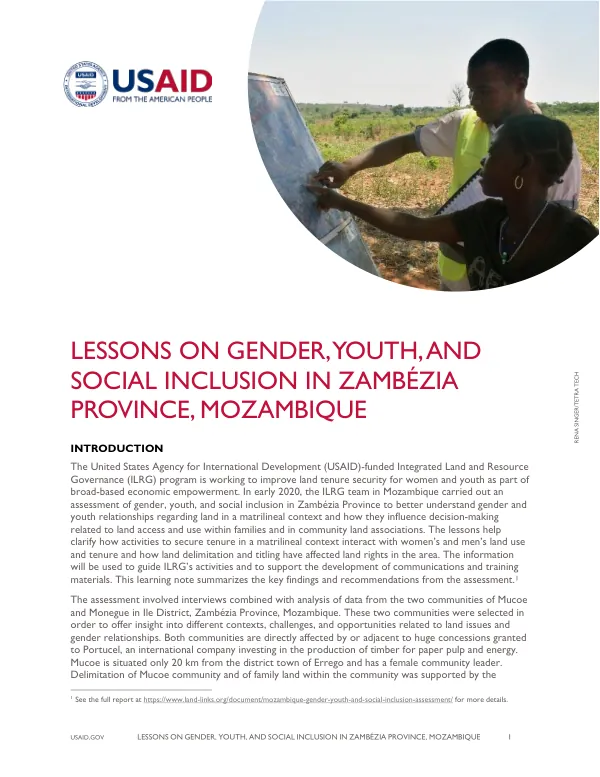
Abstract
In 2020, the ILRG program's Mozambique team conducted an assessment in Zambézia Province, focusing on gender and youth relationships and decision-making structures regarding land access and use in a matrilineal context. The assessment found that matrilineal and matrilocal customs underpin land rights for women in Ile District, where family land is inherited primarily by daughters, and husbands usually move to the wife's home upon marriage. Women are the main land users, as many men travel periodically, and there is a high percentage of female-headed households. Women's birthright to land is largely unquestioned by men and women, but men retain control over land-related decisions. Despite women's rights to land, traditional gender norms are very strong in Ile, resulting in most women having little formal education and restricted physical mobility, which constrains them from obtaining information and economic opportunities. Men often leave to study, sell goods, or look for jobs, while women are expected to stay and farm. Early marriages are common, as marriage provides families with additional labor. Divorced women keep the land, as they stay on the family land with the children after divorce or if their husband dies. However, divorce has negative economic and social implications for many women, as men are important providers of labor or cash, and divorced women are often stigmatized. Land purchases are increasing, as some men feel challenged by their lack of access to land, particularly after delimitation and confirmation of land rights, where most titleholders are women. Youth are marginalized from land, as less than 14 percent of family parcels registered during the LEGEND project were registered to a person under 30 years of age. Young women are particularly marginalized from decision-making around land. Land delimitation has led to a significant reduction in land disputes among neighbors, giving many, especially women, a new feeling of security and control over their land. However, more productive farming requires more than land security, and few have access to the inputs and technical knowledge to leverage land security into more productive or higher-value farming. Older men dominate decisions regarding land, including on issues regarding land access and conflict resolution. Women are generally poorly represented in decision-making, as they lack information on land-related decisions and opportunities. The risk of gender-based violence (GBV) shapes community participation, as participation in an association or in economic activities can generate mistrust and lead to serious problems for women. Short-term projects lack time and resources for social norms change and capacity-building, as land associations played an important role in the land delimitation process but now lack a clear purpose. Institutions perpetuate gender inequality, as men's control over community and family decisions is reinforced by multiple institutions, including agricultural extensionists, companies, and local representatives.