USAID DEC
Lessons Learned from the Enterprise Infirmary Guidelines Development Process in Cambodia
Sign inPOPULATION COUNCIL
Lessons Learned from the Enterprise Infirmary Guidelines Development Process in Cambodia
The garment industry is central to the Cambodian national economy, responsible for more than 80 percent of national export income.
2018 · 8 pages
Sign in to readA free account is required to download.
Abstract
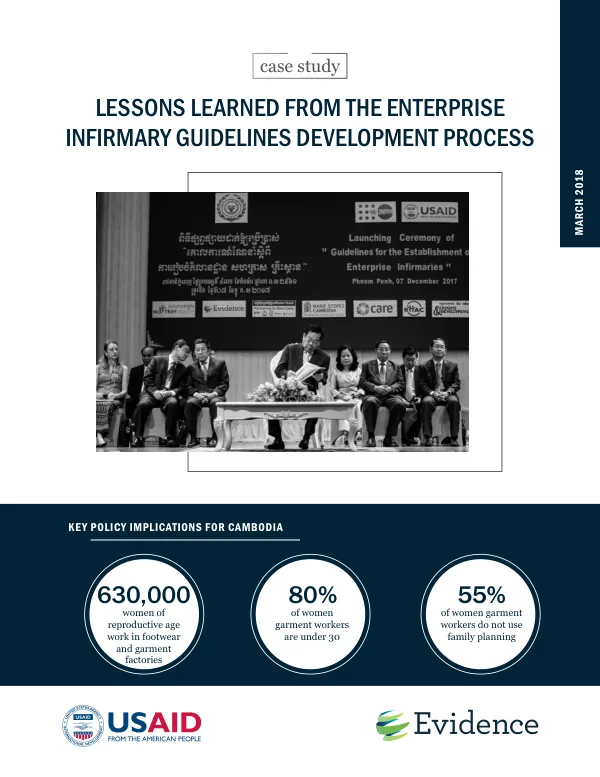
Young women of reproductive age comprise about 90 percent of Cambodia's footwear and apparel workforce, estimated at 700,000 people. The health and wellbeing of the garment industry's workforce concerns industry managers as productivity in the sector is low and poor health can be a contributing factor. Research has shown that health, particularly reproductive health, was a major concern to workers themselves. According to the Partnering to Save Lives (PSL) project, one quarter of all Cambodian women between the ages of 18 and 29 worked in garment factories. Research conducted by PSL showed that 80 percent of women in a sample from the Phnom Penh and Kandal provinces were not using family planning, while 80 percent were also under the age of 30 (PSL, 2014a). Subsequent research by the Evidence Project in 2017 in the same provinces found that contraceptive use among married women garment workers is rising, bringing the overall percentage of women garment workers not using family planning to 55%. Evidence Project research (Heng et al., 2017) found that these workers faced unique barriers and facilitating factors at individual, factory, and healthcare system levels, which influenced their health-seeking behaviors. Despite some support from family and friends, they still reported limited income and limited reproductive health and family planning education as constraints in seeking the right health services. The factory infirmaries were cited as the most accessible health providers during working hours but workers noted their limited capacity and quality. The infirmary guidelines process started in a difficult context, soon after Cambodia had experienced widespread labor disputes and strikes that halted factory production and eventually led to increases in worker wages. The Evidence Project assessed the landscape in "Workplace Health and the Garment Sector in Cambodia" (Yat, Rodehau, and Wofford 2017), which analyzed the dynamics of different stakeholders and their direct and indirect connections to garment worker well-being, health, and the policy landscape. The analysis showed that the Cambodia garment industry operates in a complex and challenging policy environment in which many issues are debated often with little agreement over causes, responsibilities, or solutions. The Royal Government of Cambodia and key agencies, the Ministry of Labor and Vocational Training (MoLVT) and Ministry of Health (MOH), were open to the idea of external organizations helping to review workplace health regulations and develop guidelines. His Excellency Dr. Huy Han Song, the Secretary of State of the MoLVT, championed the process, providing essential direction and support, without which the process would have floundered. The final product reflects his leadership and the positive engagement by the MoLVT technical staff. A Working Group comprised of technical experts of the partner organizations was formed under the Tripartite Coordination Committee for HIV/AIDS (TCC), a formal policy structure of the MoLVT. This gave legitimacy to the process and facilitated collaboration among stakeholders. The Working Group worked within a formal structure, using implementation science to elevate the importance of worker health, particularly the reproductive health of female workers, as a needed focus of occupational health and safety in garment factories and other enterprises. The guidelines were the culmination of a two-and-a-half-year policy process that included sharing evidence on the health-seeking behaviors of female garment factory workers, analyzing existing regulations, facilitating discussions with industry stakeholders, developing consensus on content and messages, and producing a guidance document. The guidelines provide quite detailed guidance to factories and infirmary staff, making it easier for enterprises to comply with current regulations and serving as a welcome tool for applying good practices for improving infirmaries, promoting healthy behaviors, and addressing women's health.