THE HEALTH POLICY PROJECT
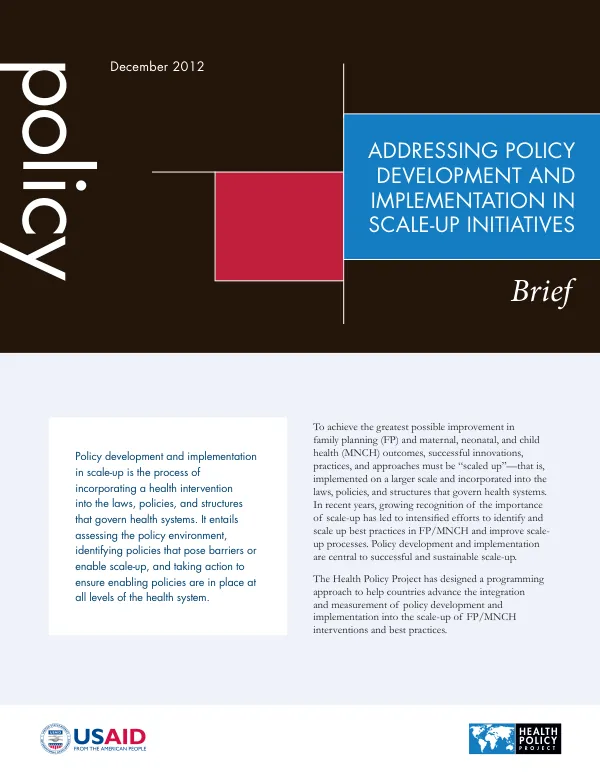
Addressing Policy Development and Implementation in Scale-Up Initiatives
Policy development and implementation are critical components of successful scale-up initiatives in family planning (FP) and maternal, neonatal, and child health (MNCH) programs.
2012 · 4 pages
Sign in to readA free account is required to download.
Abstract
To achieve the greatest possible improvement in FP and MNCH outcomes, innovations, practices, and approaches must be scaled up and incorporated into the laws, policies, and structures that govern health systems. The Health Policy Project has designed a programming approach to help countries advance the integration and measurement of policy development and implementation into the scale-up of FP/MNCH interventions and best practices. This approach focuses on policy development and implementation in scale-up, which is the process of incorporating a health intervention into the laws, policies, and structures that govern health systems. Policy development and implementation in scale-up involves assessing the policy environment, identifying policies that pose barriers or enable scale-up, and taking action to ensure enabling policies are in place at all levels of the health system. The scale-up approach emphasizes that policy work should be seen as a continuous process and an integral part of a long-term scale-up strategy. To achieve successful policy development and implementation, several key steps must be taken. First, it is essential to identify the level of policy reform needed, which involves understanding the three levels of policy that guide the health system: the legal and regulatory framework, national and state policies, and operational policies. Each level of policy affects health systems and must be considered in developing and implementing plans for scale-up. Second, it is crucial to identify the decisionmakers responsible for policy reform at each phase of scale-up implementation and at each level of the health system. This involves understanding how scaling up best practices fits within government priorities, plans, and strategies, as well as lines of authority and responsibility. Third, it is essential to identify and cultivate allies and champions who will work to garner political and financial support for the scale-up initiative. These leaders, including parliamentarians, religious leaders, and advocates for women and marginalized groups, should be strengthened to work towards keeping the issue on national and local policy agendas. Fourth, it is vital to pay attention to timing and sequencing, aligning the timing of scale-up to the political context and budget cycles. Experience has shown that gaps in funding can stall or put a sudden end to expansion efforts. Fifth, it is essential to foster communication and coordination among stakeholders on an ongoing basis, ensuring that stakeholder communication and coordination occurs continuously, not just during a one-time event. This involves involving both public and private sector stakeholders, including politicians, government officials, local government representatives, and representatives of international organizations, civil society groups, and private medical organizations. Sixth, it is crucial to identify and address policy barriers, which involves understanding the policy environment governing the health system and the structure of the health system in the context of the government structure. This includes identifying and assessing implementation barriers and their policy roots, assessing the appropriateness of the proposed solution, fostering inclusive stakeholder buy-in and commitment to take action, determining resources required for the proposed solution, implementing a solution to remove the barrier, and enacting accountability. Finally, it is essential to monitor and evaluate implementation and use data to inform the scale-up process. Scale-up strategies should have monitoring and evaluation plans with clear indicators of progress, along with systems to track service delivery and agreed-on outcomes. These systems should be linked with the group of stakeholders that is monitoring progress, and monitoring and evaluation data should be fed back into the policy process to determine what is working and what is not and to identify additional need for policy reform. The USAID-funded Gender, Policy, and Measurement Program (GPM) is facilitating a technical exchange between the Royal Government of Cambodia and the Lao PDR to enhance gender integration in health policies and structures for improved health outcomes. This activity aims to raise the profile of the leadership role of national gender mechanisms in integrating gender into health policy processes and instruments. Monitoring policy development and implementation is an integral component of the scale-up process. The first step in policy monitoring is to identify indicators measuring key activities related to the development and implementation of specific policies of interest. The next step is to collect, analyze, and disseminate data on those key indicators, which can guide the development of new, timely, and relevant policies and help health system managers to better implement existing policies that support the scale-up effort. Evaluating policy development and implementation involves determining the effect of scale-up once it has been implemented. This can be achieved through an outcome evaluation of service utilization, which could also measure improvements to the health system, or an impact evaluation of a change in policy or program design resulting from the scale-up effort on health behaviors and outcomes.