USAID DEC
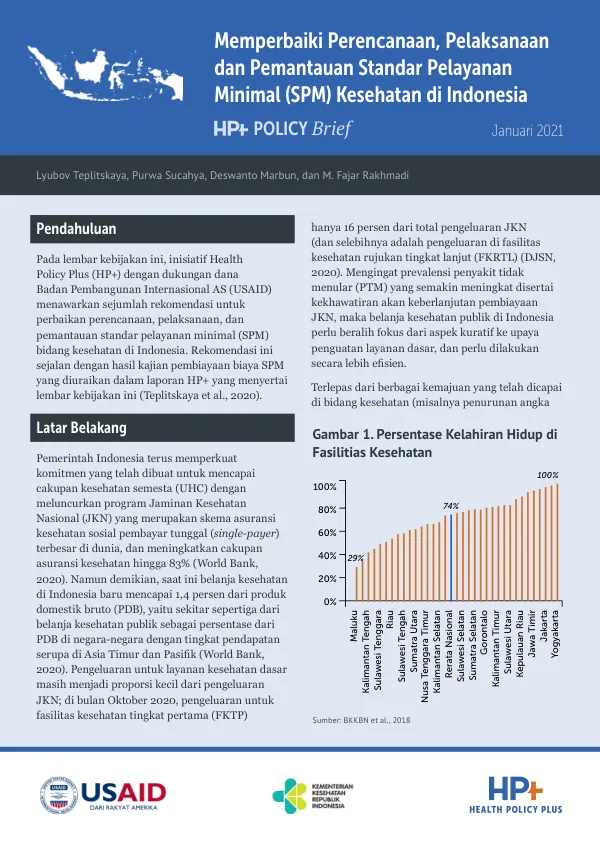
Improving Planning, Implementation, and Monitoring of Minimum Service Standards for Health in Indonesia
Sign inHEALTH POLICY PLUS
Improving Planning, Implementation, and Monitoring of Minimum Service Standards for Health in Indonesia
The Health Policy Plus (HP+) project, funded by the U.S.
2021 · 10 pages
Sign in to readA free account is required to download.
Abstract
Agency for International Development (USAID), has identified key challenges in the implementation of minimum service standards (SPM) for health in Indonesia. The government of Indonesia has established several programs and regulations to improve health inequities, including the Healthy Indonesia Program (PIS-PK) and the Nusantara Sehat program. These initiatives aim to strengthen primary healthcare service delivery, mainly through improvements in infrastructure, facilities, and human resources. The Ministry of Health (MOH) has set accreditation standards for primary healthcare facilities, private clinics, private doctors, and private dentists. The MOH has also revised guidance for the use of fiscal transfers to local governments to prioritize primary healthcare challenges. The new SPM regulation describes the minimum quality of mandatory services at the district level to reach 12 target populations for services throughout the lifecourse, along with detailed technical standards of equipment, supplies, and human resources to accomplish 100 percent of health service coverage within each fiscal year. Despite these efforts, significant challenges persist in the implementation of SPM. Districts rely on prior expenditure estimates to develop annual SPM budgets, which do not reflect actual costs to meet target population needs. An analysis of the data submitted by 67 of 514 districts indicated poor data quality and incompleteness. To address these limitations, HP+ provided technical assistance to the MOH Center for Health Financing and Insurance (PPJK) to conduct an activity-based costing study to assess costs required to meet 100 percent of targets for 12 district-level SPM for health. The study found that districts face significant challenges in planning and budgeting for SPM, including a lack of interoperability among data systems and poor coordination among stakeholders. The study also identified a need for districts to develop more accurate and evidence-based SPM cost inputs into their budgeting tools. To address these challenges, HP+ has supported the development of an interoperability guideline for use by other ministries and government agencies to access SPM data from Siscobikes for policy and other analyses. The HP+ project has also identified a need to strengthen and coordinate data and information systems for SPM at the central level. The Ministry of Home Affairs (MOHA) has the authority to set rewards and sanctions for local government leaders, but there is significant overlap in roles and responsibilities among PPJK, the MOH Center for Data and Information (Pusdatin), the MOH Bureau of Planning and Budgeting (Roren), and the MOHA, which has led to duplication in SPM data collection and information systems. This duplication has increased the administrative burden on district health offices and puskesmas, leading to significant challenges in recording and reporting SPM data. To address these challenges, the HP+ project recommends strengthening and coordinating data and information systems for SPM at the central level. This can be achieved by streamlining data collection and information systems, eliminating duplication, and improving interoperability among stakeholders. The project also recommends developing more accurate and evidence-based SPM cost inputs into budgeting tools, and providing technical assistance to districts to improve their planning and budgeting capacity for SPM.