USAID DEC
Leveraging Tradition and Science in Disaster Risk Reduction in Mongolia-2 (LTS2-Mongolia)
Sign inFOOD AND AGRICULTURE ORGANIZATION OF THE UNITED NATIONS IN GEORGIA
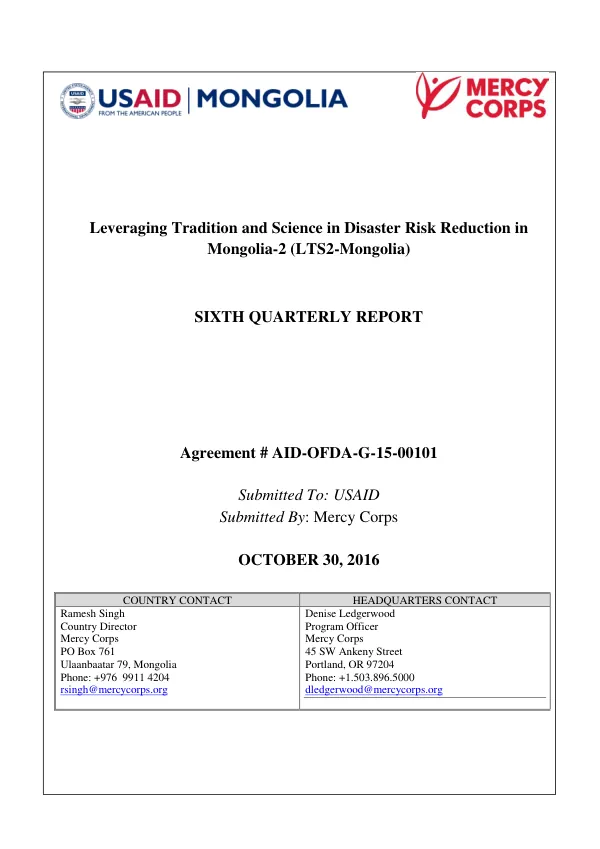
Leveraging Tradition and Science in Disaster Risk Reduction in Mongolia-2 (LTS2-Mongolia)
Leveraging Tradition and Science in Disaster Risk Reduction in Mongolia-2 (LTS2-Mongolia) is a project implemented by Mercy Corps, with funding from USAID, to support disaster risk reduction and management in Mongolia.
2016 · 7 pages
Sign in to readA free account is required to download.
Abstract
The project aims to improve the capacity of local communities, herder households, and local administrators to prepare for and respond to dzud, a severe environmental hazard that affects Mongolia's livestock and herders. The LTS2 project focuses on three main goals: completing the construction of a national SMS platform for weather and pasture information delivered directly to herders; increasing aimag and soum-level capacity to provide training on emergency planning, preparation, and mitigation to segmented audiences within the local community; and introducing local communities to sustainable mitigation activities based on the Livestock Emergency Guidelines and Standards (LEGS) to address current year dzud effects on individual households and communities. During the period from July 1, 2016 to September 30, 2016, the program focused on signing the Letter of Agreement between the Food and Agriculture Organization of the United Nations (FAO) and Mercy Corps to provide trainings on LEGS, translating the LEGS handbook from English to Mongolian, identifying regional codes for the new target soums, and preparing to connect the soums with the SMS system. Key activities and outcomes during this period include the signing of the Letter of Agreement between FAO and Mercy Corps, the translation of the LEGS handbook from English to Mongolian, the identification and addition of area codes for 282 baghs in the new target 60 soums, and the receipt of 6,231 text requests from mobile users and 5,388 responses sent to them via their cell phones through the SMS system. The SMS system has been used by herders to plan their daily work, manage their herds, cut hay, set up camps, move to new pastures, shear wool, and other activities. The project has also partnered with Alpha Labs LLC to expand the SMS system into new areas, worked with NEMA to expand the SMS system and jointly organize LEGS trainings, and partnered with FAO to translate the LEGS book into Mongolian and organize LEGS training for NEMA, Ministry of Food, Agriculture and Light Industry (MOFALI), and Mercy Corps staff. The LTS2 project is being implemented in collaboration with the National Emergency Management Agency (NEMA), the Livestock Early Warning System (LEWS), and the National Agency of Meteorology and Environment Management. The project aims to improve the capacity of local communities, herder households, and local administrators to prepare for and respond to dzud, and to reduce the negative effects of dzud on individual households and communities. The project is being implemented in 128 soums of 15 aimags in Mongolia, with a total of 49,354 direct beneficiaries and 451,616 indirect beneficiaries. The project has a total funding of $1,078,206.00, provided by USAID. The project is expected to be completed by June 30, 2017.