USAID DEC
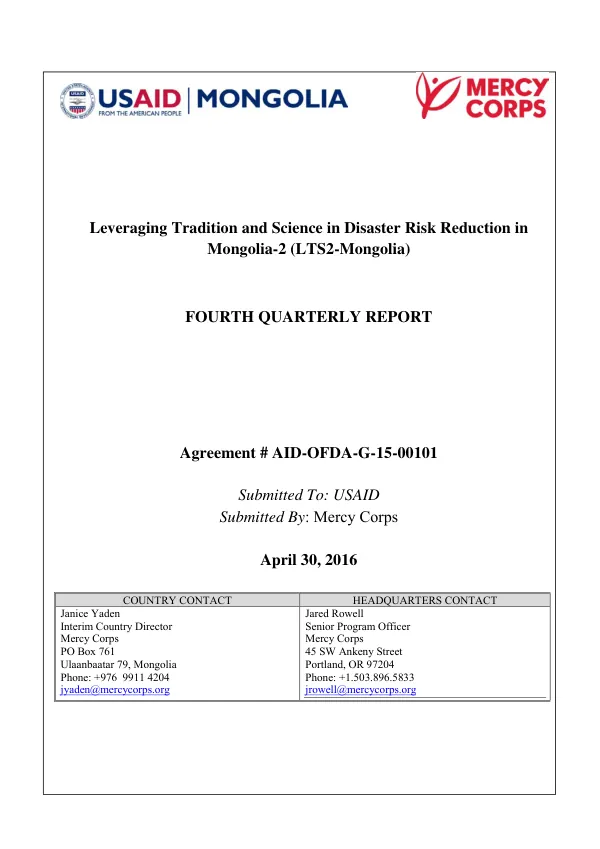
Leveraging Tradition and Science in Disaster Risk Reduction in Mongolia-2 (LTS2-Mongolia) Fourth Quarterly Report
Sign inFOOD AND AGRICULTURE ORGANIZATION OF THE UNITED NATIONS IN GEORGIA
Leveraging Tradition and Science in Disaster Risk Reduction in Mongolia-2 (LTS2-Mongolia) Fourth Quarterly Report
The Leveraging Tradition and Science in Disaster Risk Reduction in Mongolia-2 (LTS2-Mongolia) project aims to improve disaster risk reduction and management in Mongolia.
2016 · 8 pages
Sign in to readA free account is required to download.
Abstract
The project is implemented by Mercy Corps in collaboration with the National Emergency Management Agency (NEMA), the Livestock Early Warning System (LEWS), the Mongolian National Development Institute (MNDI), and Keio University. The project focuses on building the capacity of aimag and soum-level authorities to provide training on emergency planning, preparation, and mitigation to local communities. The project has two critical goals: establishing a national SMS platform for weather and pasture information and increasing aimag and soum-level capacity to provide training on emergency planning, preparation, and mitigation. The project team has been working with Keio University and the National University of Mongolia to build the SMS system in all target aimags. The team has also tested the skills and knowledge retention of training participants two months after the completion of trainings. During the fourth quarter of 2016, the project team printed and distributed 25,000 copies of the second edition of the Dzud Lessons book to target communities. The team also conducted skills and knowledge retention tests in target soums, interviewed soum leadership regarding the impact of trainings, and conducted a direct LTS training for all soum Hural chairmen with assistance from a local trainer in Hovd aimag. The feedback received during the retention tests revealed that 77.7% of training participants were actively involved in improving plans, 59.1% shared their knowledge gained at LTS2 training with others, and 39.7% increased their hay and fodder supply. The project team has also worked with the National University of Mongolia to gain access to Norwegian weather information from their website for target soums. Soum emergency plans have been approved and available in 53 of the target 69 soums. The project team has also made a request to the Food and Agriculture Organization of the United Nations (FAO) to jointly finance the translation of the LEGS book and organization of Training of Trainers. The project has made significant progress in building the capacity of aimag and soum-level authorities to provide training on emergency planning, preparation, and mitigation. The project team has also established a national SMS platform for weather and pasture information, which will enable herding communities to access, interpret, and apply weather forecast information in their management practices. The project has demonstrated that herders are eager for more information and better tools to support dzud preparation and risk mitigation. The project team has been working closely with local partners and key national emergency management actors to introduce planning tools that are simple to implement, provide increased understanding of available weather information, and identify opportunities for significant improvement in dzud outcomes through simple management tools and improved information flow. The project has also demonstrated that there is strong demand for information and management tools that can improve planning, mitigation, and management of winter weather risks. The project has been implemented in collaboration with various government agencies, including the National Emergency Management Agency (NEMA), the Ministry of Environment and Green Development (MEGD), aimag Governors' Offices, aimag agriculture and veterinary extension workers, and soum governments. The project has also received support from international organizations, including the World Bank and the United Nations Development Programme (UNDP). The project has made significant progress in improving disaster risk reduction and management in Mongolia. The project has built the capacity of aimag and soum-level authorities to provide training on emergency planning, preparation, and mitigation, and has established a national SMS platform for weather and pasture information. The project has also demonstrated that herders are eager for more information and better tools to support dzud preparation and risk mitigation.