FOOD AND AGRICULTURE ORGANIZATION OF THE UNITED NATIONS IN GEORGIA
Greenhouse Gas Emissions by Sector in Mongolia
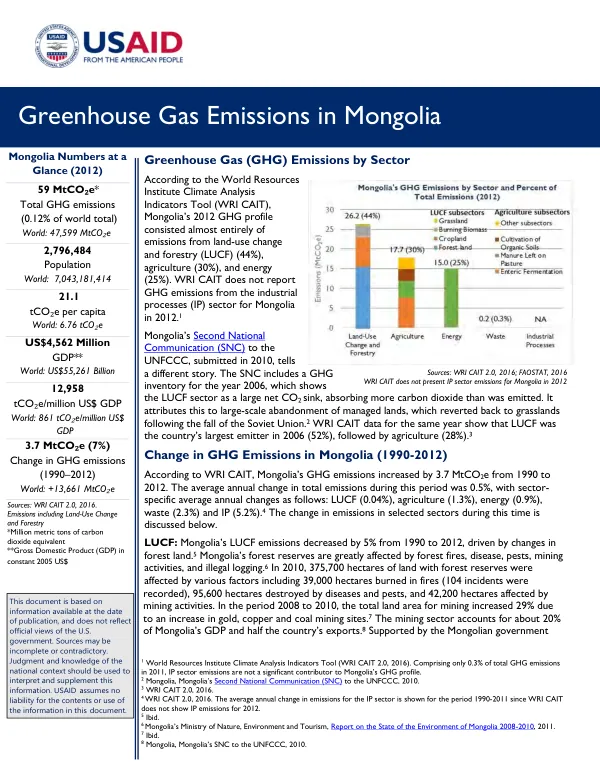
Mongolia's 2012 Greenhouse Gas (GHG) profile consisted almost entirely of emissions from land-use change and forestry (LUCF) (44%), agriculture (30%), and energy (25%).
2016 · 2 pages
Sign in to readA free account is required to download.
Abstract
The LUCF sector accounted for the largest share of emissions, primarily due to deforestation and forest degradation. Agriculture emissions grew 24% from 1990 to 2012, driven by enteric fermentation, while energy sector emissions increased 14% over the same period, mainly due to coal-fired electricity and heat generation. Mongolia's forest reserves are greatly affected by forest fires, disease, pests, mining activities, and illegal logging. In 2010, 375,700 hectares of land with forest reserves were affected by various factors, including 39,000 hectares burned in fires. The mining sector accounts for about 20% of Mongolia's GDP and half the country's exports. The sector attracts the majority of foreign investment in the country, supported by the Mongolian government through incentives and favorable conditions. The agriculture sector is a significant contributor to Mongolia's GHG emissions, driven by enteric fermentation. Herding is a business and a way of life in Mongolia, with a large segment of the population dependent on livestock production as their primary means of livelihood. The widespread and multi-year drought of 2000-2002 caused high livestock mortality in the national herd, resulting in a decrease in GHG emissions from the agriculture sector. However, livestock numbers rose again with government support in veterinary and feed services from 2004 to 2009, only to decline again in 2010 due to extreme winter events. Mongolia's GHG emissions increased 7% from 1990 to 2012, averaging 0.5% annually, while GDP grew by 147%, averaging 4.4% annually. The carbon intensity of Mongolia's economy is almost 15 times the world average, and its per-capita GHG emissions of 21 tons (including LUCF) is among the highest in the world. Mongolia has committed to reduce its GHG emissions by 14% by 2030 (excluding LUCF) compared to a business-as-usual scenario, conditioned on financial support from the international community. Proposed mitigation actions include increasing the share of renewables in electricity generation capacity, improving public transport in Ulaanbaatar, and maintaining the livestock population at appropriate levels according to the pasture carrying capacity.