USAID
Liberia: Assessment Report
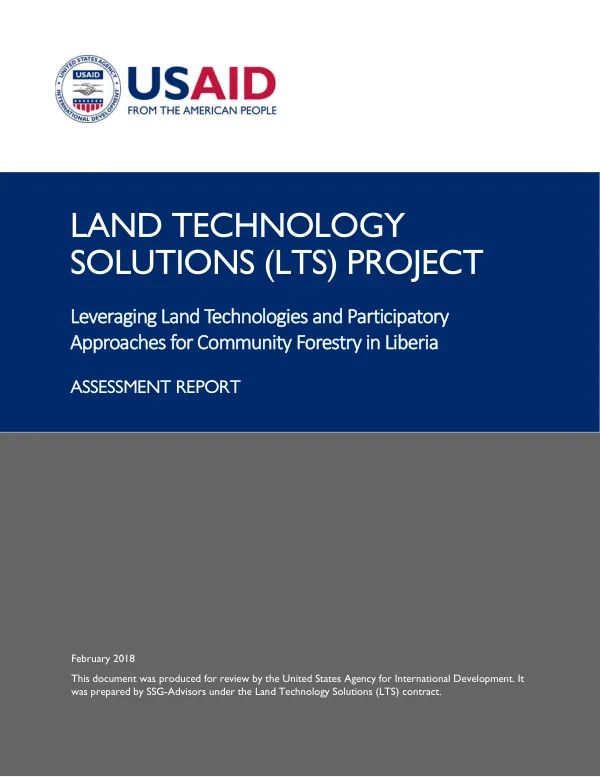
The Land Technology Solutions (LTS) Project in Liberia aimed to leverage land technologies and participatory approaches for community forestry.
2018 · 28 pages
Sign in to readA free account is required to download.
Abstract
The project, launched by USAID's E3/Land and Urban Office, sought to refine and expand the Mobile Applications to Secure Tenure (MAST) system. MAST is a suite of innovative technology tools and inclusive methods that use mobile phones and tablets to efficiently, transparently, and affordably map and document land and resource rights. The assessment report, conducted in February 2018, provided a background on the land administration and forestry management frameworks in Liberia. The report highlighted the importance of land rights and customary tenure, as well as the need for forest law and communal forest rights. The assessment trip, which took place from January 29 to February 10, 2018, involved meetings with key stakeholders and actors, including the Forest Development Authority (FDA), the Land Authority (LA), and the Community Forest Working Group (CFWG). The findings from the assessment trip revealed that MAST may present a cost-effective opportunity for the Forest Incomes for Environmental Sustainability (FIFES) program, the FDA, and the LA to work together to capture land information and promote transparency in forest governance in Liberia. This would lead to better and more sustainable uses of land and resources, as well as increased economic benefits to communities. The report proposed a conceptual approach for moving forward, which included the use of MAST to support community forestry activities in Liberia. The approach emphasized the importance of stakeholder engagement, capacity building, and technical assistance. The report also identified key risks and assumptions associated with the proposed approach, including the need for ongoing technical assistance and evidence-based monitoring and evaluation. The assessment report concluded that MAST has the potential to support community forestry activities in Liberia by providing a cost-effective and efficient means of mapping and documenting land and resource rights. The report recommended that the LTS project work closely with USAID FIFES to identify ways to implement MAST in Liberia, with a focus on stakeholder engagement, capacity building, and technical assistance. The LTS project offers a suite of services, including technology development, training and capacity building, and ongoing technical assistance and evidence-based monitoring and evaluation support. The project has been implemented in Tanzania, Burkina Faso, and Zambia since 2014, and has been used to solve a myriad of challenges that impede tenure security. The assessment report highlighted the importance of land rights and customary tenure in Liberia, as well as the need for forest law and communal forest rights. The report also emphasized the need for stakeholder engagement, capacity building, and technical assistance to support the implementation of MAST in Liberia. The report concluded that MAST has the potential to support community forestry activities in Liberia by providing a cost-effective and efficient means of mapping and documenting land and resource rights.