USAID DEC
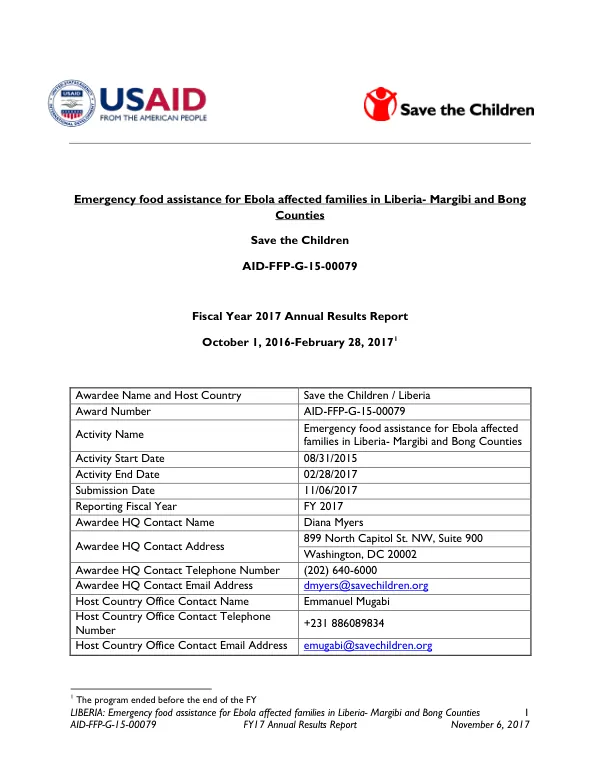
LIBERIA: Emergency food assistance for Ebola affected families in Liberia- Margibi and Bong Counties FY17 Annual Results Report
Sign inSAVE THE CHILDREN FUND
LIBERIA: Emergency food assistance for Ebola affected families in Liberia- Margibi and Bong Counties FY17 Annual Results Report
Emergency food assistance for Ebola affected families in Liberia- Margibi and Bong Counties was implemented by Save the Children in Liberia.
2017 · 163 pages
Sign in to readA free account is required to download.
Abstract
The program aimed to increase access to food through unconditional cash transfers and to increase agricultural production among households directly and indirectly affected by Ebola. The program targeted 5,000 households in the Bong and Margibi counties, consisting of 2,515 male-headed and 2,486 female-headed households, with a total of 25,129 individuals. The program, which began on August 31, 2015, was initially scheduled to end on November 30, 2016, but was extended through a three-month No Cost Extension. The report covers the project activities from October 2016 to February 2017. During this period, Save the Children conducted the sixth and seventh rounds of cash transfers, finalized the sixth and seventh post-distribution monitoring sessions, and conducted three market monitoring and stakeholder exit sensitization meetings. The program's purpose was to increase household access to food and availability of food, with a sub-purpose of increasing access to diversified and nutritious food by vulnerable households. The seventh round of cash transfers was disbursed to the program's 5,000 beneficiary households, with a total of 4,932 households redeeming their cash transfers with Save the Children staff present for verification. The cash transfers were disbursed in seven tranches over the life of the award through mobile money, a relatively new service in Liberia. The program's second sub-purpose was to increase household agricultural production. A total of 4,000 target households received awareness and orientation sessions on agronomic best practices, including integrated pest management and post-harvest handling techniques. The sessions were conducted by the three MOA staff and Save the Children staff. The program's results showed a significant reduction in the prevalence of households with severe hunger, from an average of 51.96% to 4.50%. The average household dietary diversity score improved from 4.55 to 5.92. The reduced coping strategy index (rCSI) also showed a significant reduction, from an average of 22.56 to 6.05. The results of the post-distribution monitoring sessions suggest that the program's target of using 70% of the cash grant for food was overly ambitious, with most months showing between 56% and 65% of the cash grant being used for food. The program's results also showed a significant reduction in the reduced coping strategy index (rCSI) for the selected households in both project locations (Bong and Margibi counties) over the course of the program. The average rCSI scores for the selected households at the beginning of the project were 22.56, which reduced to 4.55 after the sixth transfer, and then increased to 6.05 after the seventh and final transfer. The rCSI scores were slightly higher in Margibi County, with a score of 6.2, compared to Bong County, with a score of 6. The program's results also suggest that the average of 56.88% of the cash grant being used for food is a more realistic target. The results of the post-distribution monitoring sessions also suggest that the program's targeting criteria were effective in selecting the most vulnerable and food-insecure households affected by Ebola.