USAID DEC
Life in the Village Simulation Activity
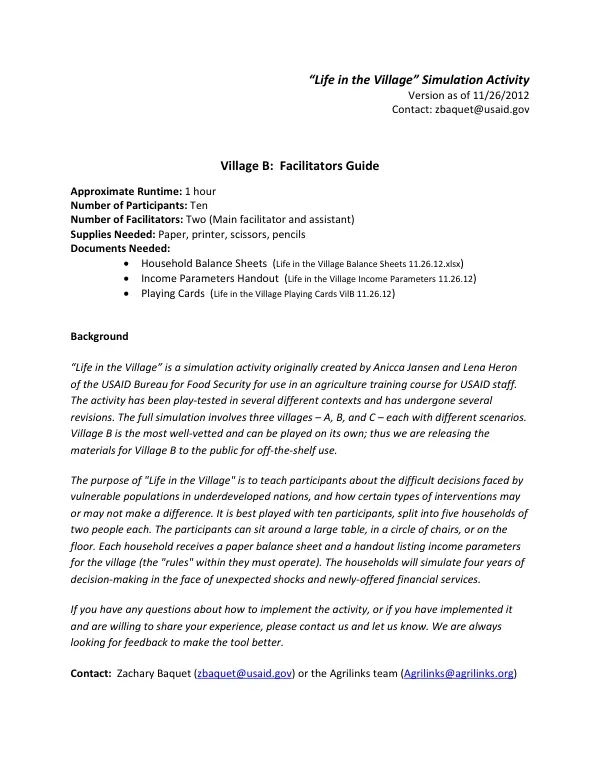
The "Life in the Village" simulation activity is a tool designed to teach participants about the difficult decisions faced by vulnerable populations in underdeveloped nations.
2012 · 9 pages
Sign in to readA free account is required to download.
Abstract
The activity was originally created by Anicca Jansen and Lena Heron of the USAID Bureau for Food Security for use in an agriculture training course for USAID staff. The simulation involves three villages, with Village B being the most well-vetted and suitable for standalone use. The purpose of the simulation is to allow participants to experience the challenges faced by households in a rural village, making decisions about resource allocation and financial management in the face of unexpected shocks and newly-offered financial services. The activity is designed for ten participants, divided into five households of two people each, and is expected to take approximately one hour to complete. The simulation begins with an introduction and review of the activity parameters, where participants are divided into households and provided with an overview of the activity. Each household receives a paper balance sheet and an income parameters handout, outlining the rules and constraints within which they must operate. The households then simulate four years of decision-making, with each year representing a single round of the game. In the first round, the households are introduced to their balance sheets and income/expense decisions, with pre-determined choices made for the first year. The facilitator invites participants to discuss their household's choices and share their experiences with the rest of the village. In subsequent rounds, the households make decisions in the face of shocks, such as unexpected events affecting their household's finances. The facilitator introduces these events as shocks, and households must factor them into their decisions. The households also have the opportunity to access financial services, weighing the risks and benefits of these services. The simulation is designed to teach participants about the impact of rural and agricultural financial services on the poor, and to help them understand the difficult decisions faced by vulnerable populations. The activity is not meant to be a game, but rather an experiential learning tool to raise awareness and understanding of the challenges faced by households in rural villages. The simulation materials include a facilitator's guide, household balance sheets, income parameters handouts, and playing cards. The activity is best played with ten participants, split into five households of two people each, and is expected to take approximately one hour to complete. The facilitator's guide provides instructions and guidance for leading the simulation, including an introduction and review of the activity parameters, household decision-making, and the introduction of shocks and financial services. The simulation is designed to be flexible and adaptable to different contexts and settings, with the facilitator able to adjust the activity to suit the needs and goals of the participants. The activity is also designed to be scalable, with the potential to be used with larger or smaller groups of participants. The "Life in the Village" simulation activity is a valuable tool for teaching participants about the challenges faced by vulnerable populations in underdeveloped nations, and for raising awareness and understanding of the impact of rural and agricultural financial services on the poor.