CARE
LIFT II Technical Process Note: Community Score Card Methodology
The Community Score Card (CSC) methodology is a participatory approach to facilitate interaction between clients, service providers, and local governance structures.
2015 · 2 pages
Sign in to readA free account is required to download.
Abstract
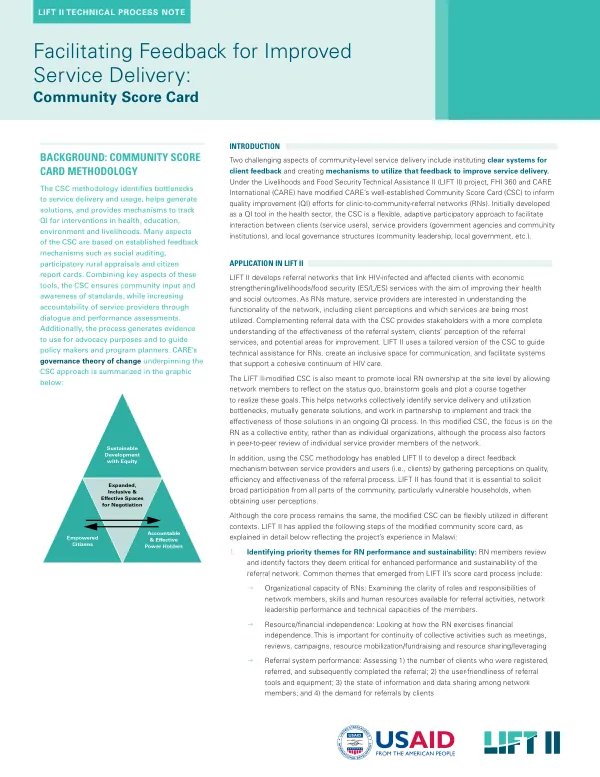
It is a flexible and adaptive tool used to identify bottlenecks in service delivery and usage, generate solutions, and track quality improvement (QI) for interventions in health, education, environment, and livelihoods. The CSC combines key aspects of established feedback mechanisms such as social auditing, participatory rural appraisals, and citizen report cards to ensure community input and awareness of standards, while increasing accountability of service providers through dialogue and performance assessments. The CSC approach is based on CARE's governance theory of change, which emphasizes the importance of community-level service delivery and the need for clear systems for client feedback and mechanisms to utilize that feedback to improve service delivery. The CSC has been modified and applied in various contexts, including the Livelihoods and Food Security Technical Assistance II (LIFT II) project, which aims to improve the health and social outcomes of HIV-infected and affected clients through economic strengthening and livelihoods services. The LIFT II-modified CSC is tailored to guide technical assistance for clinic-to-community-referral networks (RNs) and create an inclusive space for communication and systems that support a cohesive continuum of HIV care. The CSC process involves identifying priority themes for RN performance and sustainability, defining what success looks like under each theme, scoring indicators, and interface and action planning. The CSC has been found to be effective in promoting local RN ownership, increasing accountability of service providers, and generating evidence for advocacy purposes and policy guidance. The CSC approach has been applied in various contexts, including Malawi, where it has been used to identify priority themes for RN performance and sustainability, such as organizational capacity, financial independence, and referral system performance. The CSC has also been used to develop a direct feedback mechanism between service providers and users, gathering perceptions on quality, efficiency, and effectiveness of the referral process. The success of the CSC depends on how it is implemented, and it is essential to establish an open dialogue about the CSC and its goals with service providers or clients well before implementation. Not all action items and recommendations generated during the CSC process can be easily enacted, and it is therefore important that senior officials and decision-makers in the referral network member organizations are involved in the process to ensure that decisions and changes are made. The CSC approach has been recognized as a valuable tool for improving service delivery and promoting community-level service delivery. It has been supported by various organizations, including the World Bank, WaterAid Ghana, and Prism Research, which have developed resources and guidance on the CSC approach. The CSC has also been applied in various contexts, including the health sector, education, environment, and livelihoods, and has been found to be effective in promoting community-level service delivery and improving service outcomes.