USAID DEC
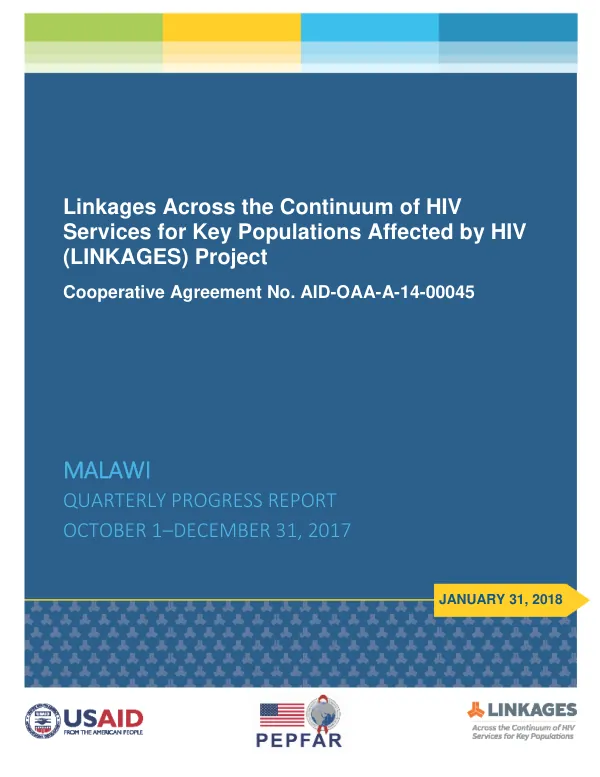
Linkages Across the Continuum of HIV Services for Key Populations Affected by HIV (LINKAGES) Project
Sign inUSAID
Linkages Across the Continuum of HIV Services for Key Populations Affected by HIV (LINKAGES) Project
The LINKAGES Project in Malawi aimed to increase the availability of comprehensive prevention, care, and treatment services for key populations affected by HIV.
2018 · 23 pages
Sign in to readA free account is required to download.
Abstract
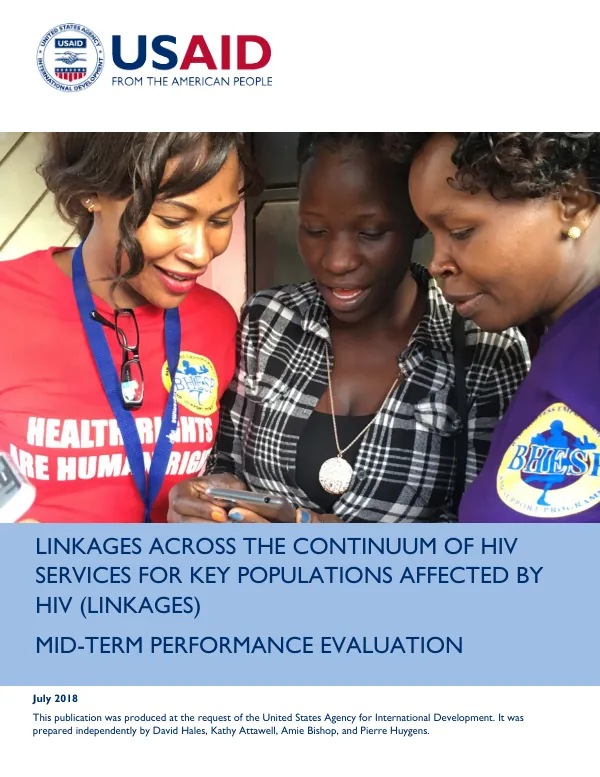
The project was implemented in six districts, including Blantyre, Lilongwe, Mzuzu, Zomba, Machinga, and Mangochi. The project's overall goal was to improve the continuum of care for key populations, including female sex workers (FSWs), men who have sex with men (MSM), and transgender people. In the quarter from October 1 to December 31, 2017, the project reached 5,766 FSWs with HIV prevention interventions, including 2,378 known HIV-positive individuals. A total of 1,503 FSWs were tested for HIV and received their results, with 333 testing positive and 308 initiated on treatment. The project also distributed 993,756 condoms, 122,391 condom-compatible lubricants, and provided STI screening and treatment services to 2,940 FSWs, 639 MSM, and 16 transgender people. The project implemented peer-led tuberculosis (TB) screening training for implementing partners, which aimed to contribute to early TB case detection and timely referrals for treatment. A total of 98 participants were trained, including peer educators, peer navigators, outreach workers, and district coordinators. The project also engaged with the transgender community to provide comprehensive services, including health talks, condom and lubricant distribution, GBV screening, and mobilization for medical services. The project's district-level HIV cascades showed varying results across the six districts. In Blantyre, 1,107 FSWs were reached with messages, condoms, and lubricants, with 57 testing HIV-positive and 46 initiated on treatment. In Lilongwe, 1,910 FSWs were reached, with 62 testing HIV-positive and 55 initiated on treatment. The project's overall retention rate for FSWs initiated on treatment was 92.5 percent, with a target of 100 percent. The project also conducted GBV trainings in all six districts to improve GBV screening and response. Additionally, the project reoriented outreach teams and drop-in center-based healthcare workers on the short message service (SMS2) system to monitor stigma and discrimination in clinical service provision and identify KP-friendly health facilities. The project finalized HIV self-testing and pre-exposure prophylaxis (PrEP) protocols to be submitted to the local institute review board (IRB) in Q2. The project's overall achievement in this quarter was the successful hosting of the USAID midterm evaluation consultants, who collaborated with a local consultant to review the performance of the LINKAGES program from inception in 2015 to 2017. The process involved check-in meetings with the LINKAGES technical team, key informant interviews with stakeholders, and focus group discussions with outreach workers, peer navigators, and peer educators.