FAMILY HEALTH INTERNATIONAL
Afya Nyota ya Bonde Y4 Quarter 2 Report (January 1, 2021- March 31, 2021)
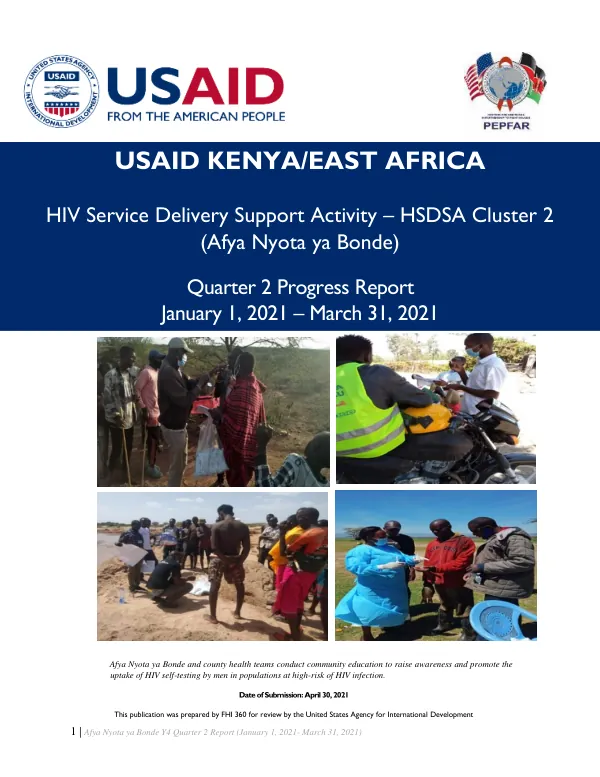
The HIV Service Delivery Support Activity, Afya Nyota ya Bonde, is a program implemented by FHI 360 in Kenya, with funding from the United States Agency for International Development (USAID).
2021 · 73 pages
Sign in to readA free account is required to download.
Abstract
The program aims to increase access to HIV prevention, testing, and treatment services, particularly for priority populations. The program operates under five objectives, which are outlined below. Objective 1 focuses on increasing the availability and use of combination prevention services for priority populations. This includes providing HIV prevention services, promoting Voluntary Medical Male Circumcision (VMMC), increasing access to Pre-Exposure Prophylaxis (PrEP) for discordant couples and other high-risk populations, and preventing and responding to Gender-Based Violence (GBV). The program also aims to increase the availability and use of combination prevention services for key and priority populations. Objective 2 targets the increased uptake of targeted HIV testing services (HTS). The program focuses on increasing access to facility-based HTS services, which enables individuals to receive HIV testing and counseling. Objective 3 aims to improve linkage to treatment for individuals newly testing HIV positive. The program employs a no-missed-opportunity approach to ART enrollment, increasing ART uptake among HIV-positive children and adolescents, and providing prevention of mother-to-child transmission of HIV services. Objective 4 focuses on improving commodity security for optimal patient outcomes. The program strengthens capacity in commodity management and pharmacovigilance, commodity quantification, forecasting, and reporting, and commodity security and management. Objective 5 involves long-term follow-up of patients receiving care and treatment services, including laboratory and logistical support. The program increases cervical cancer screening and treatment for women living with HIV aged 25-65 years, strengthens laboratory capacity to ensure timely and high-quality laboratory services, and provides lab and logistical support. The program also includes performance monitoring, which involves tracking progress against set targets and objectives. This includes monitoring progress on gender strategy, environmental mitigation and monitoring, links to other USG programs, links with GOK agencies, USAID Forward, sustainability and exit strategy, and subsequent year work plan. In terms of achievements, the program has made significant progress in increasing access to PrEP, HIV testing, and ART services. The program has also improved linkage to treatment for individuals newly testing HIV positive, and strengthened commodity security and management. Additionally, the program has increased cervical cancer screening and treatment for women living with HIV aged 25-65 years, and strengthened laboratory capacity to ensure timely and high-quality laboratory services. The program has also made progress in implementing its gender strategy, environmental mitigation and monitoring, and links to other USG programs. The program has also made progress in its sustainability and exit strategy, and has developed a subsequent year work plan. In terms of financial information, the program has received funding from USAID and has allocated resources to implement its objectives and activities. The program has also reported on its financial performance, including expenditures and income. Overall, the Afya Nyota ya Bonde program has made significant progress in increasing access to HIV prevention, testing, and treatment services, particularly for priority populations. The program has also strengthened commodity security and management, and improved linkage to treatment for individuals newly testing HIV positive.
Related documents