USAID DEC
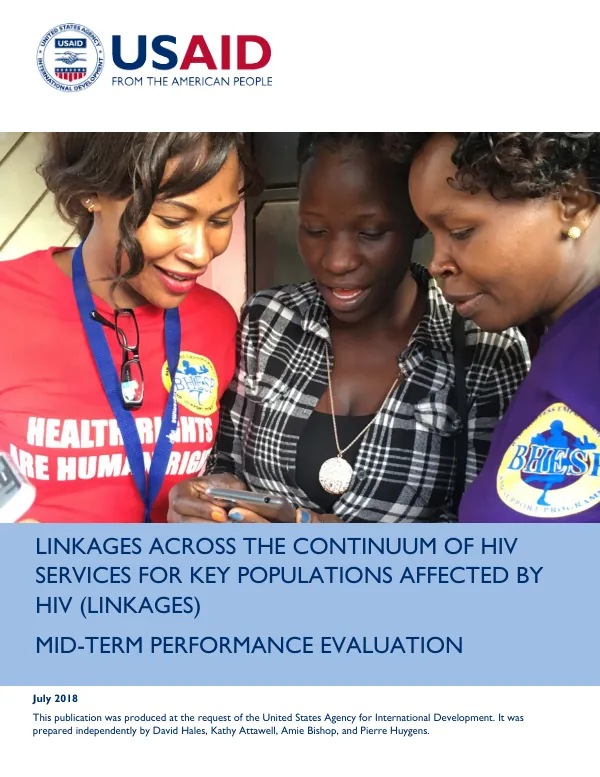
Linkages Across the Continuum of HIV Services for Key Populations Affected by HIV (Linkages) Mid-Term Performance Evaluation
Sign inLINKAGES
Linkages Across the Continuum of HIV Services for Key Populations Affected by HIV (Linkages) Mid-Term Performance Evaluation
The Linkages Across the Continuum of HIV Services for Key Populations Affected by HIV (LINKAGES) project is a USAID-funded initiative implemented in 30 countries.
2018 · 185 pages
Sign in to readA free account is required to download.
Abstract
The project aims to increase the availability of and demand for HIV services for key populations and strengthen national government and civil society capacity to deliver these services. Key populations include men who have sex with men, sex workers, people who inject drugs, and transgender individuals. The project's objectives include increasing the number of key population members being reached, tested for HIV, and initiating treatment. As of the mid-term evaluation in July 2018, all project countries have reported increases in key population numbers being reached, tested for HIV, and initiating treatment. This achievement is significant, given the challenging contexts in which the project operates, including policy, systems, and structural barriers. LINKAGES is making a notable contribution to national responses for key populations by raising government awareness, supporting the provision of essential HIV services, and building the capacity of local implementing partners. The project is also introducing innovative approaches and identifying promising practices that can engage "harder to reach" groups, increase HIV testing uptake and yield, and improve treatment uptake and retention. However, achieving some targets has been a challenge, and losses to follow-up occur at multiple points in the HIV cascade. Key lessons from the project include the importance of demonstrating "proof of concept" to justify national scale-up, ensuring planning is informed by sound situation analysis and data, adapting approaches to local and hyperlocal contexts, strong collaboration with public sector providers of clinical services, sustaining capacity development for organizations providing services to key populations, and strengthening structural interventions. The project's mid-term performance evaluation highlights the need for continued support and adaptation to address the complex challenges faced by key populations. The evaluation recommends that the project focus on sustaining capacity development, strengthening structural interventions, and adapting approaches to local contexts. Additionally, the evaluation suggests that the project should prioritize the development of a global follow-on mechanism to support key populations. The evaluation team conducted a comprehensive review of project documents and data, as well as key informant interviews and country visits. The evaluation found that the project has made significant progress in achieving its goals and objectives, but also identified areas for improvement. The evaluation's findings and recommendations provide valuable insights for the project's continued implementation and future development. The project's success in increasing key population numbers being reached, tested for HIV, and initiating treatment is a testament to the effectiveness of the LINKAGES approach. However, the project's challenges and lessons learned highlight the need for continued support and adaptation to address the complex challenges faced by key populations. The evaluation's recommendations provide a roadmap for the project's continued success and highlight the importance of sustaining capacity development, strengthening structural interventions, and adapting approaches to local contexts.