USAID DEC
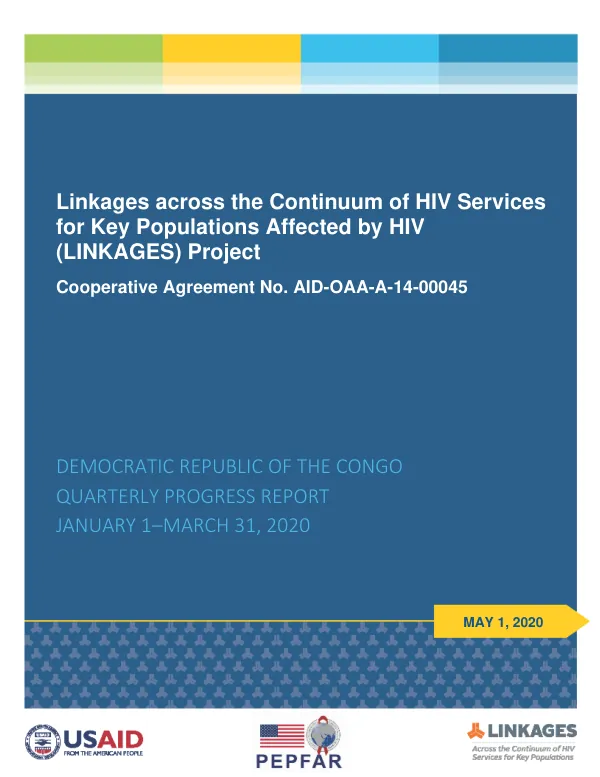
LINKAGES Quarterly Report (January 1–March 31, 2020) – Democratic Republic of the Congo
Sign inFHI 360
LINKAGES Quarterly Report (January 1–March 31, 2020) – Democratic Republic of the Congo
The LINKAGES project in the Democratic Republic of the Congo (DRC) continued to improve performance across most key PEPFAR indicators during the second quarter of FY20.
2020 · 24 pages
Sign in to readA free account is required to download.
Abstract
The project focused on optimizing interventions to improve case finding among key populations (KPs) and priority populations (PPs) through tailored strategies such as the enhanced peer outreach approach (EPOA) and respondent-oriented testing (DOR). This effort strengthened the capacity of peer navigators (PNs) to accelerate linking individuals to antiretroviral therapy (ART) as well as reaching more clients of female sex workers (FSWs) through campaigns. Case finding for men who have sex with men (MSM) moved from 8 percent in Q1 to 10 percent in Q2. Case finding remains at 12 percent for FSWs while linkage to care was improved for FSWs, 92 percent in Q2 compared to 90 percent in Q1; and clients of FSWs (CFSWs), 95 percent in Q2 up from 84 percent in Q1. Significant achievements have been made against challenging targets allocated this year for CFSWs. A total of 2,081 CFSWs were tested (12 percent case finding) compared to 1,083 in Q1. During the quarter, EPOA strategy contributed to 17 percent in overall case finding of which 41 percent of positive cases were CFSWs. The project achieved 63 percent of the annual target for pre-exposure prophylaxis (PrEP) (577/910). LINKAGES DRC activities in Likasi within the Haut-Katanga province ended in the second quarter of FY20 with the start of the COVID-19 pandemic in DRC during the first days of March. Major accomplishments for the reporting period include reaching 3,956 FSWs, 884 MSM, and 2,146 CFSWs with HIV prevention interventions; testing and receiving results for 3,548 FSWs, 783 MSM, and 2,080 CFSWs; and enrolling 405 FSWs, 71 MSM, and 193 CFSWs in clinical care and initiating them on treatment. The project is working in three provinces: Kinshasa, Haut-Katanga, and Lualaba with 17 health zones and 24 health institutions. Prevention services are provided at the community level and treatment services are offered at clinical institutions supported by other USAID implementation partners. The project works in close collaboration with IHAP-supported health institutions, including five in Kinshasa, eight in Haut Katanga, and four in Lualaba. All HIV-positive individuals tested at the community level are linked to health facilities where LINKAGES' peer navigators (PNs) are based in order to assure follow-up with key populations living with HIV (KPLHIV) for psychological support, adherence, retention to treatment, and monitoring viral load (VL) services. The project uses a differentiated models approach, including drop-in centers, point of distribution, and service delivery points (DIC, PODI, SDP). With the support of well-trained staff, including a nurse, the LINKAGES DRC project runs four DICs, as well as four PODI hosted in the DICs, and one SDP (Haut-Katanga). In addition to prevention and support services, the community centers initiate ART treatment, refill ART for stable patients, conduct follow-up for adherence/retention and VL services while also offering PrEP services as well as sexually transmitted infection (STI) screening and treatment. The project achieved 75 percent of the annual target for all populations reached, 23 percent of the annual testing target was reached, and 35 percent for HIV-positive annual target. The DRC project is performing well regarding case detection: 99 percent is from KP and PP activities. The gap between results versus targets for testing and case detection for all populations is due to a disconnect between the scope and resources for the project (focusing on KPs and PPs) versus the targets allocated by USAID this fiscal year which encompass all populations and are extremely high (52,768 testing, 3,905 cases to detect).
Related documents