USAID DEC
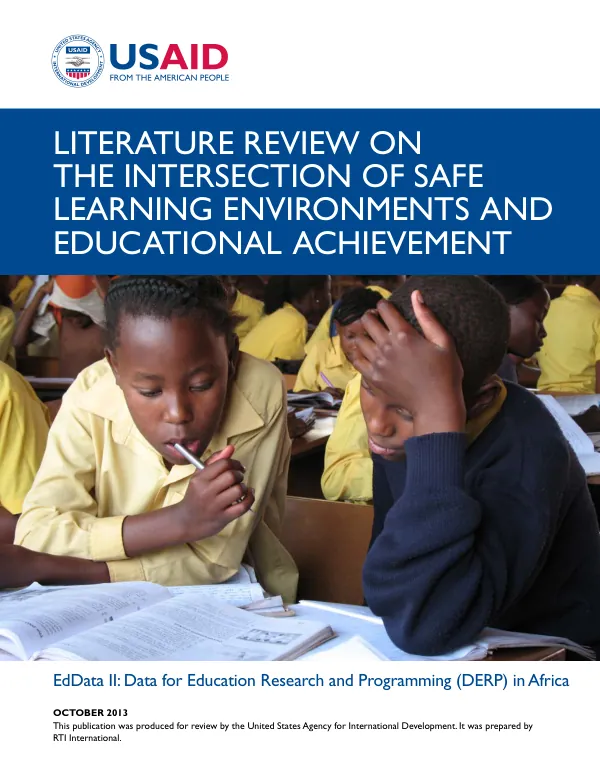
Literature Review on the Intersection of Safe Learning Environments and Educational Achievement
Sign inRTI INTERNATIONAL
Literature Review on the Intersection of Safe Learning Environments and Educational Achievement
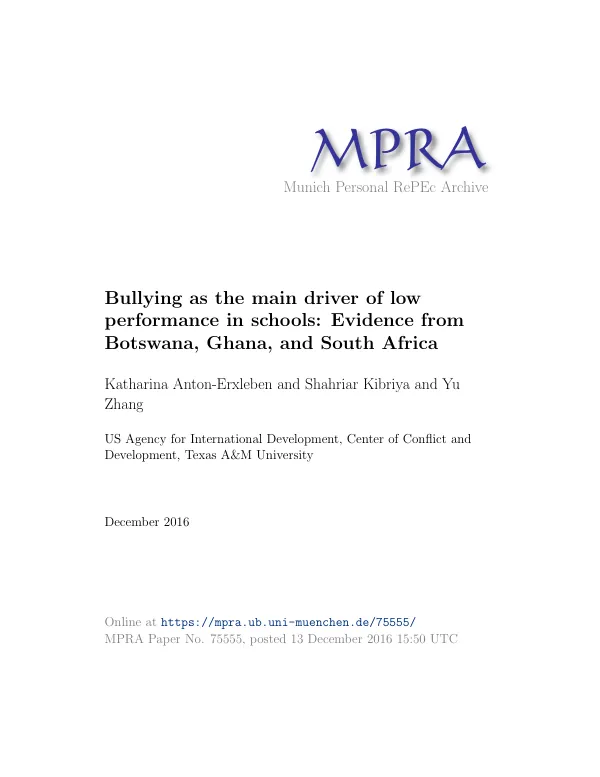
School violence is a global phenomenon that affects educational achievement in developing countries.
2013 · 42 pages
Sign in to readA free account is required to download.
Abstract
Research indicates that more than half of South African and Botswanan children report being bullied approximately weekly. Bullying is one of the most common forms of school violence, encompassing corporal punishment, cruel and humiliating forms of psychological punishment, sexual and gender-based violence, fighting, and gang-related violence. Vulnerability to bullying and other forms of school violence varies among students based on gender, sexuality, disability, stigmatized illness, refugee status, or minority group status. In some contexts, violence is a commonplace feature of schools as institutions, rather than an aberration. School-related gender-based violence, such as sexual harassment and assault, has been highlighted as a cause for concern in developing countries for more than a decade. Conceptualizing school violence as profoundly gendered provides a coherent framework for analysis and helps to bring boys into sharper focus as both potential victims and perpetrators. Research from developing countries indicates that school violence affects educational achievement through diverse causal pathways. Direct and indirect experiences of school violence can lead to school avoidance, low student participation in class, and decreased academic motivation. Studies have shown that students in developing countries whose principals reported moderate problems with discipline and safety in their schools had substantially lower reading achievement than students whose principals reported hardly any problems in these matters. The Progress in International Reading Literacy Study (PIRLS) 2011 found that students in developing countries who experienced school violence had lower reading achievement than their peers. Similarly, research from developed countries indicates that school violence affects educational achievement through diverse causal pathways. For example, a study found that students who were bullied at school had lower reading achievement than their peers. Another study found that students who experienced school-related gender-based violence had lower mathematics achievement than their peers. Research has also identified other negative outcomes associated with school violence, including decreased enrollment, attendance, and completion rates. In addition, school violence can lead to other negative outcomes, such as increased dropout rates, decreased academic motivation, and decreased self-esteem. The Trends in International Mathematics and Science Study (TIMSS) 2011 found that students in developing countries who experienced school violence had lower mathematics achievement than their peers. Overall, the available evidence suggests that school violence has a significant impact on educational achievement in developing countries. The causal pathways through which school violence affects educational achievement are diverse and complex, and further research is needed to fully understand the relationship between school violence and educational achievement.