WORLD BANK
Loan covenants and Legal Considerations
Loan covenants and legal considerations are essential components of financial agreements, particularly in transactions involving environmental and social risks.
3 pages
Sign in to readA free account is required to download.
Abstract
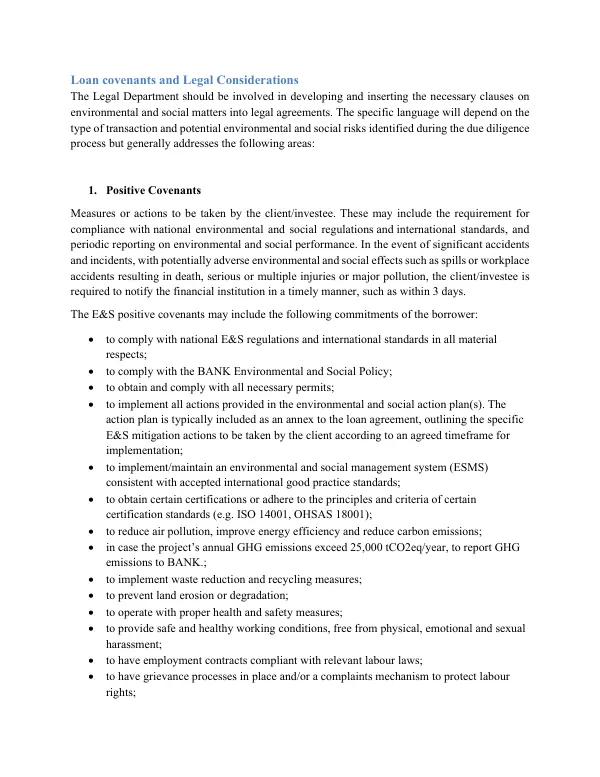
The legal department plays a crucial role in developing and inserting necessary clauses into legal agreements to mitigate these risks. Positive covenants, which are measures or actions to be taken by the client or investee, typically address compliance with national environmental and social regulations and international standards. These covenants may include requirements for periodic reporting on environmental and social performance, notification of significant accidents or incidents, and implementation of environmental and social action plans. The action plan outlines specific mitigation actions to be taken by the client according to an agreed timeframe for implementation. Environmental and social positive covenants may also include commitments such as compliance with national and international regulations, obtaining necessary permits, implementing an environmental and social management system, and reducing air pollution and carbon emissions. Additionally, clients may be required to report greenhouse gas emissions, implement waste reduction and recycling measures, prevent land erosion or degradation, and operate with proper health and safety measures. Negative covenants, on the other hand, are actions that the client or investee should refrain from undertaking. These may include participating in activities listed in the bank's exclusion list or entering into business relationships with persons or entities on financial sanctions lists. Conditions precedent are requirements that the client must fulfill prior to disbursement of funds by the bank. These may include proof of valid permits and licenses, an opinion from an independent environmental and social advisor, completion of mitigation actions stipulated in the corrective action plan, and nomination of an environmental and social manager. In the event of default, the bank may cancel the transaction and declare all amounts owed by the client to become immediately due and payable. This may include specifying a time period, such as 30 days, during which the client can resolve the issue after notification by the bank. A corrective action plan is typically included as an annex to the legal agreement, outlining specific mitigation actions to be taken by the client according to an agreed timeframe for implementation. Financial institution staff periodically monitor clients and, as necessary, require the preparation of periodic environmental and social performance reports for review by the financial institution. Material non-compliances with environmental and social clauses are considered a breach of contract, which constitutes an event of default under the terms of the legal agreement.
Related documents