USAID DEC
The Time is Now to Accelerate Women's Public Procurement: Overview: Snapshots of Countries and Programs
Sign inBANYAN GLOBAL
The Time is Now to Accelerate Women's Public Procurement: Overview: Snapshots of Countries and Programs
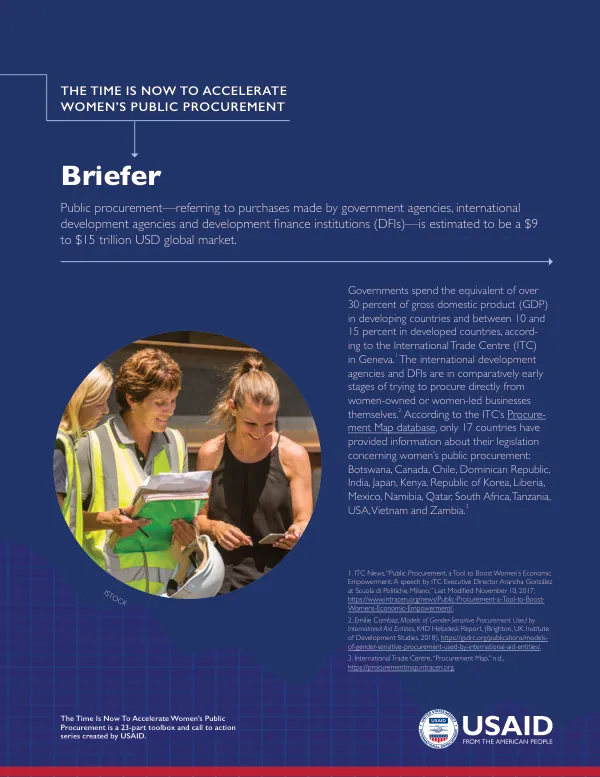
The Dominican Republic has implemented a women's public procurement program, with a focus on increasing the participation of women-owned businesses in government contracts.
2021 · 2 pages
Sign in to readA free account is required to download.
Abstract
The program aims to promote economic empowerment and reduce poverty among women. Key strategies include setting aside a portion of government contracts for women-owned businesses and providing training and capacity-building programs for women entrepreneurs. In Kenya and South Africa, two countries have implemented different approaches to promoting women's public procurement. Kenya has a set-aside program, which allocates a portion of government contracts to women-owned businesses. South Africa, on the other hand, uses a preferential point system, which awards points to women-owned businesses in the bidding process. Both countries have seen significant increases in the participation of women-owned businesses in government contracts. The International Trade Centre (ITC) has made available important content, including legislative and regulatory language on 17 women's public procurement programs from their Procurement Map platform. The ITC has also shared a portion of the SheTrades Outlook analyses of their business and procurement ecosystem assessments, which enable countries to strengthen their ecosystems for women's public procurement and access to markets. The World Bank has launched an advisory program in partnership with UN Women to catalyze access to public procurement contracts for women entrepreneurs. The program aims to increase the participation of women-owned businesses in government contracts and promote economic empowerment among women. The program has been implemented in several countries, including Senegal, where it has shown promising results. The International Finance Corporation (IFC) has launched an effort to bring women-owned businesses into the oil, gas, and mining supply chain. The program aims to increase the participation of women-owned businesses in the extractive industries and promote economic empowerment among women. The program has been implemented in several countries, including those in Africa and Asia. The European Union has had internal resistance to preferential public procurement policies for women-owned enterprises, but there is growing debate on how to leverage public procurement for social goals, including gender equality. The Women20 Working Group on Women's Entrepreneurship and Finance will be exploring whether women-owned businesses could become an area of focus within a carve-out for small and medium enterprises or micro, small, and medium enterprises. India has mandated corporate social responsibility (CSR) spending, requiring large corporations to pay at least 2 percent of their average net profit from the previous three years into a CSR fund. Much of this funding has focused on poverty alleviation, but there is increasing corporate interest in aligning their CSR strategies with further investment in education, entrepreneurship, and skills building for women and girls. Buenos Aires, Argentina, has instituted a local women's procurement program, with a new women-owned business seal, to encourage equitable procurement. The program aims to promote economic empowerment among women and increase the participation of women-owned businesses in government contracts.