USAID DEC
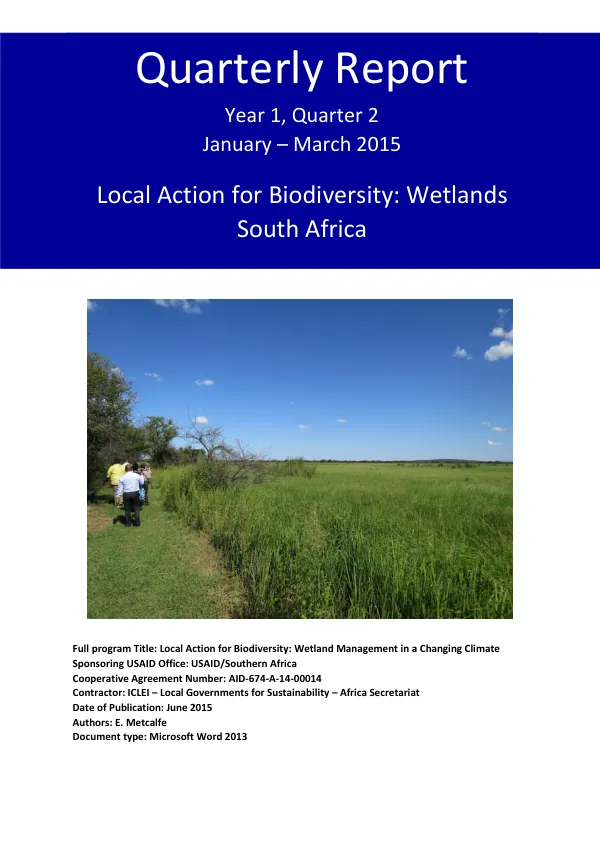
Local Action for Biodiversity: Wetland Management in a Changing Climate
The Local Action for Biodiversity: Wetland Management in a Changing Climate project aims to protect priority natural wetland resources in South Africa.
2015 · 47 pages
Sign in to readA free account is required to download.
Abstract
The project's goal is to enable the supply of ecosystem services, promote resilient communities, and support sustainable local economies under a changing climate. The project's objectives include improving local government and citizen knowledge of biodiversity and wetlands, integrating ecosystem services and biodiversity into local government planning, and implementing on-the-ground wetland projects. During the second quarter of 2015, the project continued its start-up phase and initiated project activities. A two-page brochure was developed to promote the project to external stakeholders and provide a quick introduction to the project for municipalities. The brochure includes information on the project's aims and objectives, as well as the project partners. Both a 'screen' version and folded print version were created. The project team invited 11 municipalities to participate in the project, with the exception of Sarah Baartman (Cacadu) municipality, which did not have the necessary environmental department to undertake biodiversity-focused work. Despite efforts to persuade the municipality, the answer remained unchanged. The project team then approached the next municipality on the list, Amathole District Municipality, which was invited to the project after unanimous agreement from the Project Steering Committee. Inception meetings were held with the 11 municipalities to provide more detail on the project and to understand the local context in each municipality. The meetings were attended by various stakeholders, including external partners, local and district municipal officials, and offical from the Department of Environmental Affairs. The project presentation included discussions on local policies pertaining to biodiversity and wetlands, current projects and programmes in the municipality, and key points of leverage, including threats and concerns. The project team also held a Wetlands Workshop at Waterberg District Municipality, where the project was presented to the municipal officials and external stakeholders. The project team has contact details of its members, but sourcing the correct contact details for non-ICLEI Africa members was required. The Department of Environmental Affairs provided critical assistance in this regard. The project's work plan includes activities such as monitoring and evaluation, organisational capacity building, and implementing on-the-ground wetland projects. The project's monitoring and evaluation framework will track progress against the project's objectives and indicators. The project team will also conduct organisational capacity building activities to enhance the capacity of local governments to manage and protect wetlands. The project's planned activities for the following quarter include continuing the inception meetings with the remaining municipalities, finalising the project's work plan, and initiating the project's monitoring and evaluation framework. The project team will also continue to engage with external stakeholders and partners to promote the project and its objectives.