USAID DEC
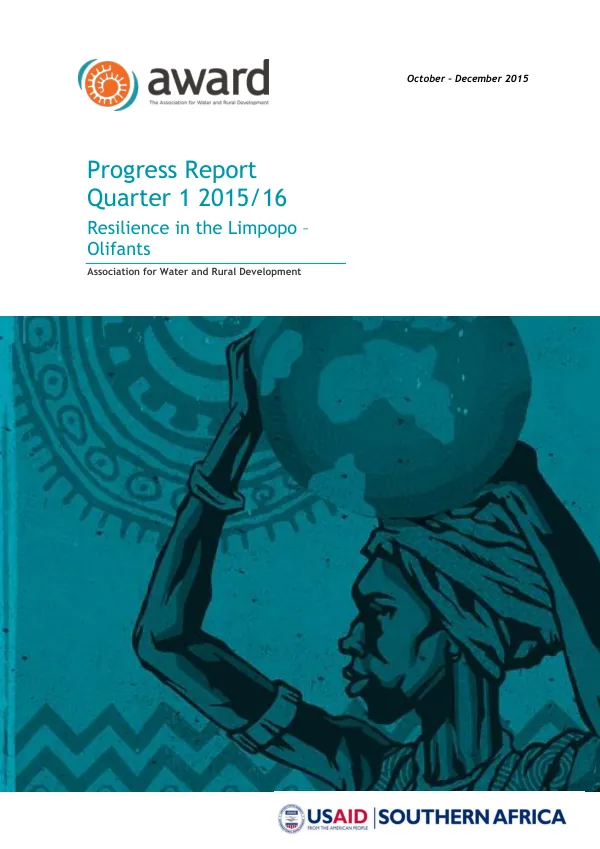
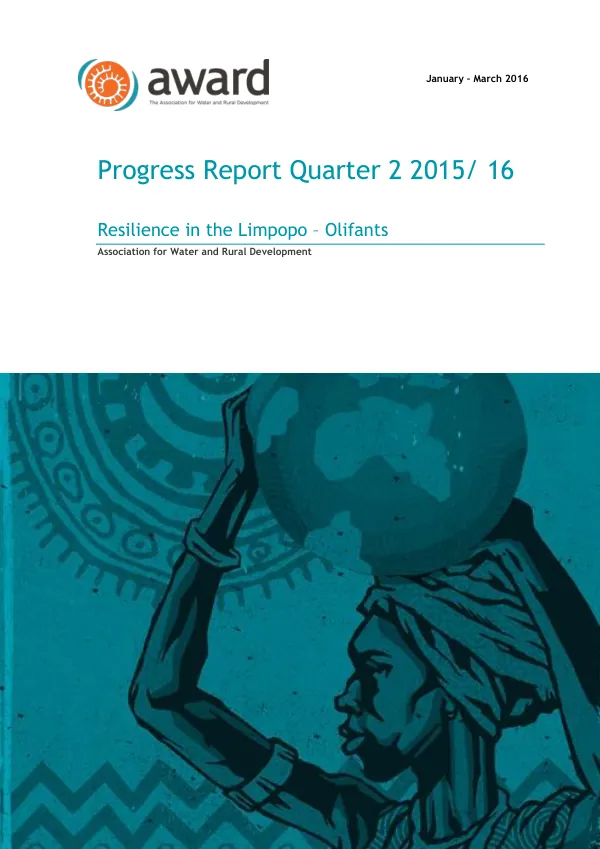
Progress Report Quarter 2 2015/16: Resilience in the Limpopo – Olifants Association for Water and Rural Development
Sign inUSAID
Progress Report Quarter 2 2015/16: Resilience in the Limpopo – Olifants Association for Water and Rural Development
The Resilience in the Limpopo – Olifants Association for Water and Rural Development (AWARD) is a non-profit organization registered in South Africa.
2016 · 31 pages
Sign in to readA free account is required to download.
Abstract
The organization is implementing the USAID-funded RESILIM O project, which aims to enhance the resilience of the Limpopo River Basin ecosystem and associated livelihoods. The project is implemented in collaboration with various partners and stakeholders. The project focuses on four key areas: institutionalizing systemic, collaborative planning and action for resilience; enhancing long-term water security and protection; conserving biodiversity and sustainably managing high-priority ecosystems; and reducing vulnerability to climate change and other factors. The project also aims to ensure good programmatic governance through developing and maintaining organizational capacity and effectiveness. In Quarter 2 of 2015/16, the project made significant progress in terms of numbers, both at institutional and individual levels. The number of women reached during this reporting quarter increased notably, due to the expansion of the project into the Mozambique part of the Olifants and the number of people and institutions reached by AWARD through workshops based on Systems Dynamic Modelling (SDM), Cultural-Historical Activity Theory (CHAT), and Values, Social, Technical, Ecological, Economic, Political drivers (VSTEEP). The project's activities in Quarter 2 included ongoing strategic planning, internal and external capacity development, and field-based implementation of various activities guided by the 2016 Workplan. AWARD staff members participated in and attended various meetings, workshops, and activities as invited by strategic partner institutions. The project's performance in Quarter 2 shows significant improvement in Climate Change and Natural Resources Management (NRM) and/or Biodiversity programs. However, there is a need to review some of the targets set for the project, as the roll-out of capacity development and training at both individual and institutional levels is dependent on the availability of stakeholders. This has proven to be a challenge, especially in the case of government partners. The project's financial management and governance summaries and reports are also contained in this report. The project's progress in Quarter 2 is a significant step towards achieving its objectives, and the project will continue to work towards ensuring the resilience of the Limpopo River Basin ecosystem and associated livelihoods. The Olifants River Basin is a particular concern due to its heavy rainfalls, which make it the largest contributor to the transboundary Limpopo Basin. Despite the enabling legislative framework for water reform in South Africa since 1998, the integrity of most rivers in this catchment continues to degrade both in terms of quality and quantity. The ongoing degradation is caused by a complex interaction of factors that vary for different parts of the catchment and along the length of the river. The project's activities in Quarter 2 included the implementation of various initiatives aimed at enhancing the resilience of the Limpopo River Basin ecosystem and associated livelihoods. These initiatives included the development of capacity building and training programs for stakeholders, the implementation of field-based activities guided by the 2016 Workplan, and the participation of AWARD staff members in various meetings, workshops, and activities.