CENTER FOR EDUCATIONAL DEVELOPMENT
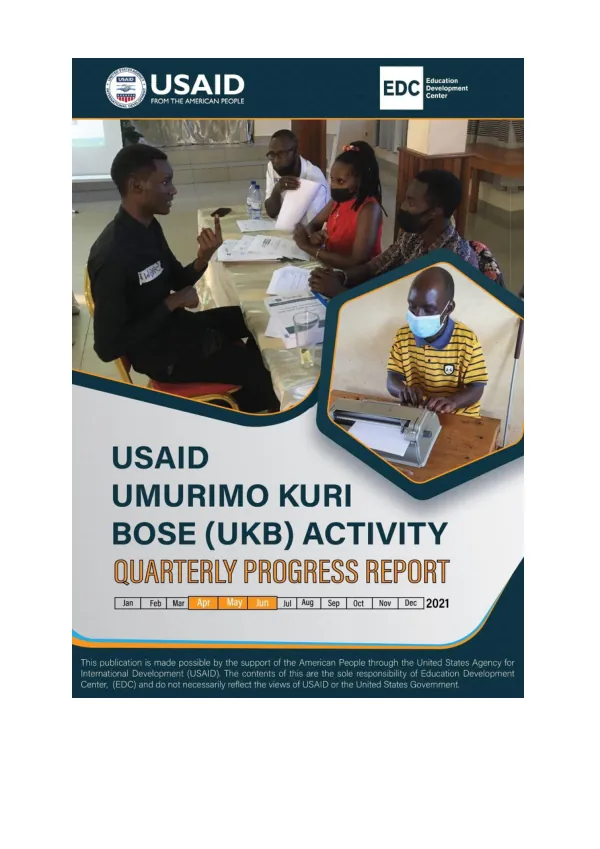
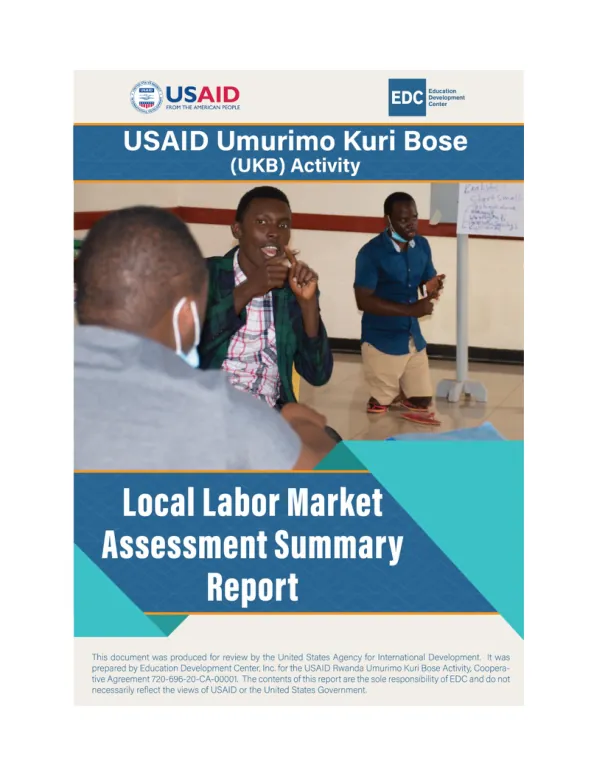
Local Labor Market Assessment for the Umurimo Kuri Bose (UKB) Activity
The Local Labor Market Assessment (LLMA) for the Umurimo Kuri Bose (UKB) activity was conducted in 12 project districts in Rwanda.
2021 · 21 pages
Sign in to readA free account is required to download.
Abstract
The assessment aimed to understand local labor market dynamics, including emerging or existing demand for wage- and self-employment, skills sought after by employers, and the landscape of providers and their accessibility to youth with disabilities. UKB's objectives are to foster a more inclusive workforce development system by increasing youth employability skills, empowerment, engagement, and equity, and promoting an inclusive and enabling environment for youth with disabilities to access and succeed in employment. The activity will serve 1,560 youth, focusing on youth with disabilities, and a subset of 360 youth without disabilities will be included to promote an inclusive learning environment and address stigma against people with disabilities. The LLMA used a combination of key informant interviews and focus group discussions, based on an approach and tools developed under USAID Huguka Dukore Akazi Kanoze (HDAK). This methodology is intended to be replicable by local organizations, enabling them to update and refresh labor market information on an annual or semi-annual basis. The findings from the LLMA highlight several high-demand opportunities in common across districts, including construction and agriculture, tailoring/knitting, shoemaking, and leatherworks, and equipment repair and maintenance. Employers uniformly seek employees with soft skills, citing a lack of these skills as a limiting factor when hiring all youth, including youth with disabilities. Youth with disabilities face challenges in accessing training and education due to stigma and limited access to training or education. Many youth, particularly those with disabilities, have trouble accessing training because they lack foundational skills, such as communication skills, work ethics, character, and punctuality, which are in high demand by employers. The report recommends several actions to address these challenges, including ensuring work readiness/entrepreneurship training is offered for all youth, building work-based learning opportunities into training, recognizing prior and rapid response training, increasing youth knowledge, skills, and access to financial services, and disability mainstreaming. Employers, district officials, and training providers expressed an interest in learning more about how to better serve youth with disabilities. To address these audiences, it would be important to understand the incentives that underpin their interests, such as no- or low-cost options for accessibility. The LLMA information should be broadly disseminated to facilitate planning at the local level to address skills mismatches, training providers, district officials, employers, and youth should all be informed of findings and engaged in updating or validating these findings in the future. Youth Development Alliances provide a structure for knowledge sharing and exchanging information that can be harnessed to communicate LLMA findings across a broad range of stakeholders. In each of the 12 districts, UKB partners were able to identify work-based learning opportunities for youth with disabilities to move into, as well as people who were interested in disability inclusion. As the UKB Activity deepens engagement with private sector partners and district officials, the aim is to shift mindsets by demonstrating the value that youth with disabilities can bring as employees or as entrepreneurs.