CENTRE FOR SUPPORTING GREEN DEVELOPMENT
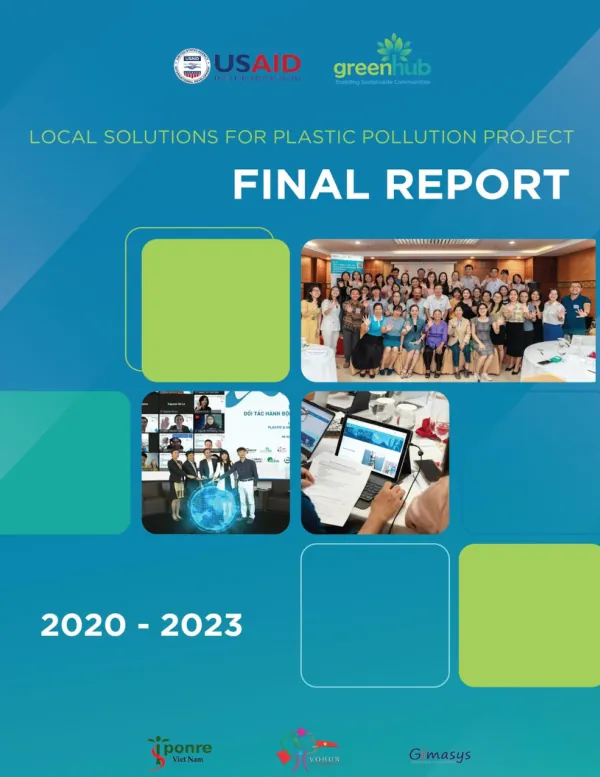
Local Solutions for Plastic Pollution (LSPP) Project Final Report
The Local Solutions for Plastic Pollution (LSPP) project was implemented from 2020 to 2023 under the Vietnam Local Works for Environmental Health Project.
2023 · 33 pages
Sign in to readA free account is required to download.
Abstract
The project focused on collaborative mechanisms to reduce plastic pollution, emphasizing capacity development and collective actions on plastic pollution. The project was implemented by the Centre for Supporting Green Development (GreenHub), a Vietnamese NGO, with Sub-Awardees Vietnam One Health University Network (VOHUN), ISPONRE (Ministry of Natural Resources and Environment), and the private sector company GIMASYS. Project sites included Hanoi, Da Nang, and Hoi An city. Establishment of the Plastic and Health Action Partnership (PHA) was the core project initiative. Based on an analysis of plastic pollution impacts and organization networking in Vietnam, the project identified a clear absence of linkages between plastic and health. The LSPP team made the plastic and health linkage as the core focus and established the PHA in 2021 with 26 organizations representing the government, business, Vietnamese and foreign NGOs. Member capacity building on Social and Behavior Change and System Thinking were emphasized. The PHA conducted workshops and webinars, training of female journalists, database creation, documentary video production, National and City level 'Sharing Fora' analyzing best practices in plastic waste reduction, and promoting a Circular Economy approach to reduce the health effects of plastic. Capacity building was a key component of the project, with a focus on organizational and project management, as well as training of trainers (TOT) on plastic waste and its health impacts. The project also established the Plastic Health Action Partnership (PHA), which brought together 26 organizations to address the issue of plastic pollution and its impact on health. The PHA conducted various activities, including workshops, webinars, training of female journalists, database creation, documentary video production, and National and City level 'Sharing Fora'. The project also focused on developing Joint Action Plans (JAPs) as a key component of the project's approach to developing locally-led models. The development of JAPs was a central aspect of the project's approach, and was used to bring together stakeholders and develop plans to address plastic pollution. The project also conducted a systematic review of business resources and provided small grants for plastic innovation. The project faced several challenges, including the need to engage with a wide range of stakeholders, including government agencies, businesses, and civil society organizations. The project also had to navigate the complex policy environment in Vietnam, including the need to engage with multiple levels of government and to develop policies that were effective in reducing plastic pollution. Despite these challenges, the project made significant progress in reducing plastic pollution and promoting a Circular Economy approach. The project's findings highlighted the importance of collaborative mechanisms in reducing plastic pollution, and the need for capacity development and collective actions on plastic pollution. The project also found that the development of Joint Action Plans (JAPs) was a key component of the project's approach to developing locally-led models. The project's recommendations included the need for continued engagement with stakeholders, including government agencies, businesses, and civil society organizations, as well as the need to develop policies that were effective in reducing plastic pollution.
Related documents