USAID DEC
Low-Cost Method to Monitor Patient Adherence to HIV Antiretroviral Therapy Using Multiplex Cathepsin Zymography
Sign inUSAID DEC
Low-Cost Method to Monitor Patient Adherence to HIV Antiretroviral Therapy Using Multiplex Cathepsin Zymography
A low-cost method to monitor patient adherence to HIV antiretroviral therapy using multiplex cathepsin zymography was developed and tested in a study conducted in South Africa.
2016 · 2 pages
Sign in to readA free account is required to download.
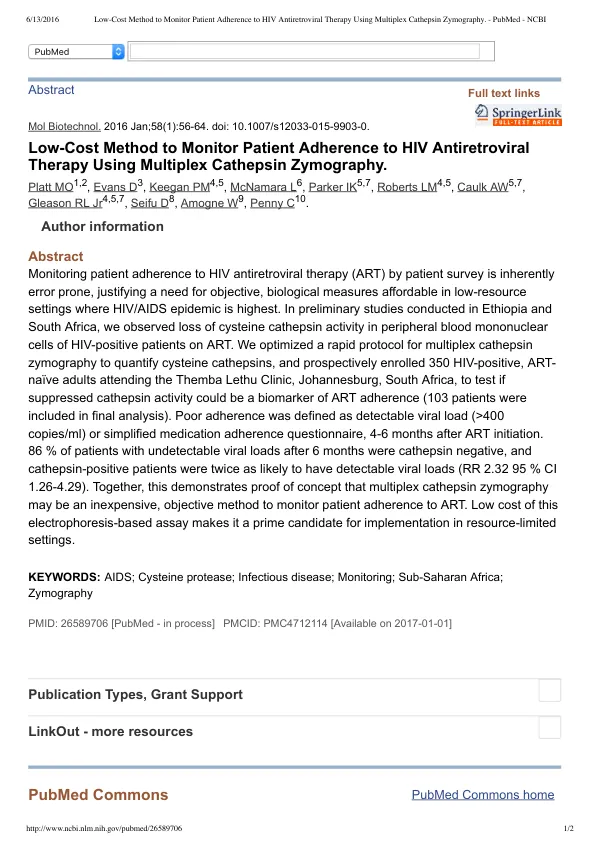
Abstract
The method involves analyzing cysteine cathepsin activity in peripheral blood mononuclear cells of HIV-positive patients on antiretroviral therapy (ART). Researchers observed that patients with undetectable viral loads after six months of ART treatment were more likely to have suppressed cathepsin activity. The study enrolled 350 HIV-positive, ART-naive adults attending the Themba Lethu Clinic in Johannesburg, South Africa. Patients were prospectively monitored for six months, and their adherence to ART was assessed using a simplified medication adherence questionnaire and viral load measurements. The results showed that 86% of patients with undetectable viral loads after six months were cathepsin-negative, indicating suppressed cathepsin activity. In contrast, patients who were cathepsin-positive were twice as likely to have detectable viral loads, suggesting poor adherence to ART. The study demonstrated that multiplex cathepsin zymography may be an inexpensive and objective method to monitor patient adherence to ART. The low cost of this electrophoresis-based assay makes it a prime candidate for implementation in resource-limited settings, where the HIV/AIDS epidemic is most prevalent. The study's findings have significant implications for the monitoring and management of HIV/AIDS in low-resource settings. By providing an objective and affordable method to assess patient adherence, healthcare providers can identify patients who require additional support or intervention to maintain optimal treatment outcomes. This, in turn, can help to improve treatment outcomes and reduce the transmission of HIV in affected communities. The study's results also highlight the potential of multiplex cathepsin zymography as a biomarker of ART adherence. The method's ability to detect suppressed cathepsin activity in patients with undetectable viral loads suggests that it may be a useful tool for monitoring treatment response and identifying patients who are at risk of treatment failure. Further research is needed to validate the method's accuracy and reliability in different populations and settings.