USAID DEC
Low-Cost Private Schools in the DRC: Needs, Challenges, and Recommendations to Improve Access and Quality for All
Sign inCHEMONICS
Low-Cost Private Schools in the DRC: Needs, Challenges, and Recommendations to Improve Access and Quality for All
The Democratic Republic of Congo (DRC) faces significant challenges in providing quality education to its citizens.
2020 · 8 pages
Sign in to readA free account is required to download.
Abstract
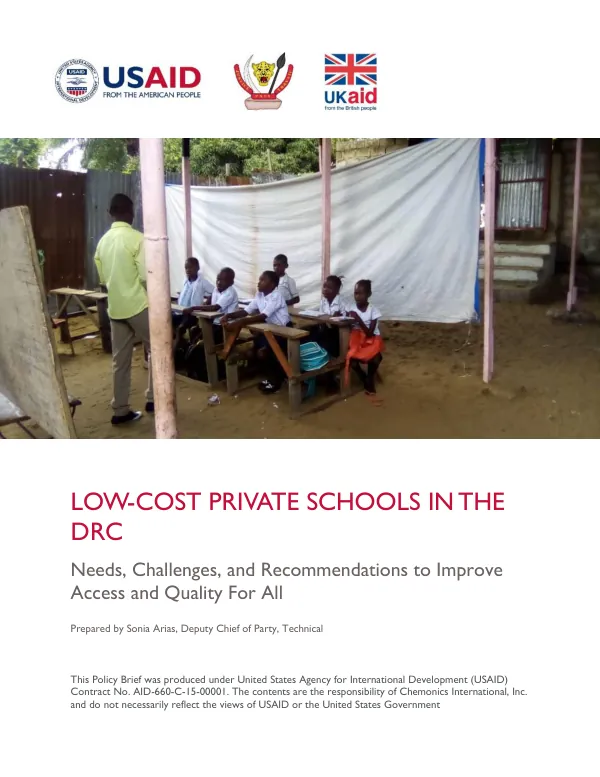
The public education system has experienced a steady decline in quality since the 1990s, with insufficient numbers of schools, poor infrastructure, low teacher remuneration, and ineffective management. As a result, the number of low-cost private schools (LCPS) has grown, offering an alternative to public education for many poor and vulnerable families. In the DRC, LCPS are increasingly providing education to densely populated urban and peri-urban areas, where the government has not kept up with demand. These schools are often the only education providers in these areas, and they are not always regulated or monitored effectively. The DRC's education policy requires all private schools, including LCPS, to maintain the same standards as public schools. However, evidence suggests that this is not the case, with LCPS suffering from issues such as poor infrastructure, low teacher capacity, lack of materials, and high dropout rates. The DRC's education system is complex, with 70 percent of public schools managed and run by religious networks, 20 percent managed by the government, and 10 percent private. The government pays teacher salaries in both conventionnée and non-conventionnée schools. This hybrid system has added layers of bureaucracy and provides the rationale to impose school fees on already stretched households. The DRC's laws and statutes acknowledge the right to education for all and declare its obligation to provide free, inclusive, and quality public education. However, the country is still far from achieving the Sustainable Development Goal (SDG) 4.1 and is not in compliance with the Abidjan Principles. The situation is unlikely to improve soon, given the challenging socio-economic conditions in the DRC and the growing demand for public education. The question of how to support countries like the DRC to meet the demands of education without exacerbating inequalities between and within private and public sectors is a pressing issue. Funders and implementing partners must consider how to support equitable improvements in learning for vulnerable populations, rather than heightening inequalities. The Global Partnership for Education has opted not to fund for-profit provision of education, while USAID views investment in non-state schools as critical to meeting the demand for education. The ACCELERE!1 project, implemented by USAID, aimed to improve educational outcomes for girls and boys through improved teaching and learning, reduced barriers to education, and increased transparency of school governance structures. The project's findings suggest that LCPS in the DRC face significant challenges, including poor infrastructure, low teacher capacity, and lack of materials. The project also highlights the need for more research on private education in conflict-affected or fragile states, such as the DRC. In conclusion, the DRC faces significant challenges in providing quality education to its citizens, and the growth of LCPS has become a critical issue. Funders and implementing partners must consider how to support equitable improvements in learning for vulnerable populations, rather than heightening inequalities. The DRC's education system is complex, and addressing the challenges facing LCPS will require a nuanced and multifaceted approach.