USAID DEC
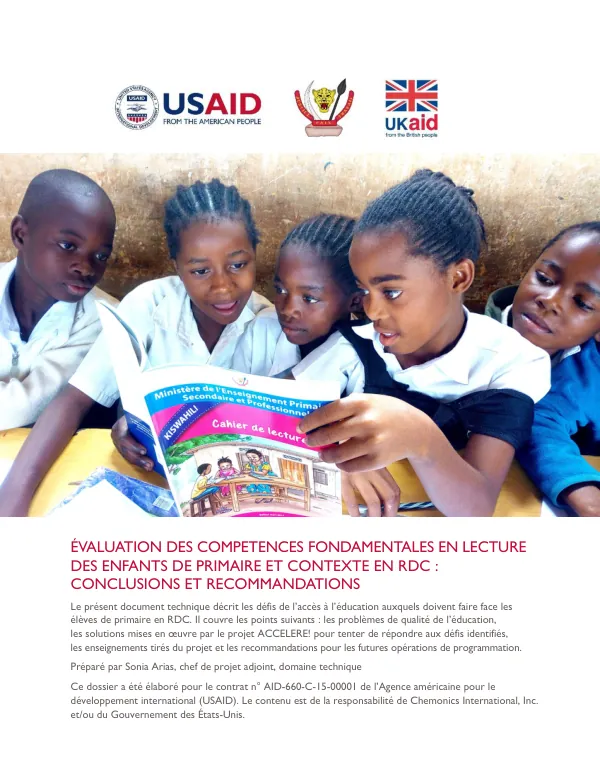
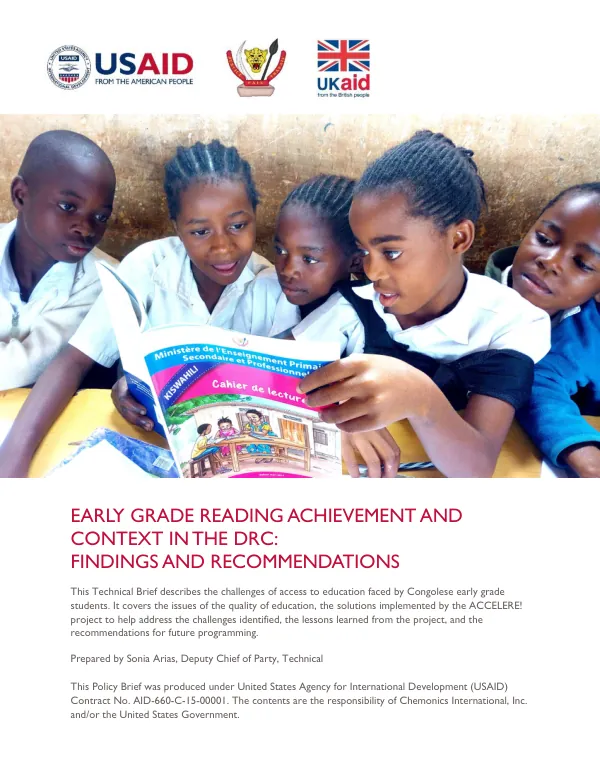
Early Grade Reading Achievement and Context in the DRC: Findings and Recommendations
Sign inCHEMONICS
Early Grade Reading Achievement and Context in the DRC: Findings and Recommendations
The Democratic Republic of Congo (DRC) is one of the lowest-income countries in the world, with significant challenges to education access and quality.
2020 · 8 pages
Sign in to readA free account is required to download.
Abstract
The country's education system faces instability, conflict, and limited infrastructure, resulting in low levels of educational access and outcomes. According to the Human Development Index, the DRC consistently ranks at the bottom, with 15 million primary school-age children, of whom 3.5 million are out of school. Learning levels are extremely low, with 68% of grade 3 and 4 students unable to read a single word of simple text in a 2013 assessment. The Government of the DRC, through the Ministry of Education, revised its education policy through the Reform Act (Loi cadre) of 2014 and launched an Education Sector Strategy (Stratégie Sectorielle pour L’éducation et la Formation, SSEF) for 2016-2025. In support of the government's efforts, USAID and UKAID launched a US$133 million program named ACCELERE!1 (A!1) in 2015 to improve learning outcomes for students in formal and accelerated learning programs. The program aimed to improve early grade reading outcomes through the development and distribution of teaching and learning materials and in-service teacher professional development in four national languages. The main goal of the A!1 project is to improve early grade reading outcomes through the development and distribution of teaching and learning materials and in-service teacher professional development in four national languages. The project's approach to monitoring and evaluating outcomes and impact on student reading skills consisted of a baseline assessment conducted in 2015, two large-scale formative evaluations to monitor and inform program implementation in 2017 and 2018, and an impact evaluation of students' reading skills with endline data collected in 2019. The 2018 monitoring EGRA results indicated that students' and learners' reading levels are improving, with an overall upward performance trajectory noted from 2015 to 2018. Mean scores increased (and in some cases doubled) in both écoles primaires (EP or primary schools) and centres de rattrapage scolaire (CRS or alternative learning program schools), a reflection of the decline in "zero scores," or percentage of students scoring 0 on a given skill. An analysis of the 2018 monitoring results identified contextual factors correlated with stronger student reading performance, including teacher attendance at A!1 reading trainings, student reading at home, student speaking French at home, learning in a child-friendly classroom environment, student speaking national language at home (Kiswahili provinces), and school receipt of a kit (Kiswahili provinces). However, the results also indicated that students' and learners' scores on the vocabulary sub-tasks declined in national languages and French, suggesting a need for improvement in the quality or time spent on oral language instruction. A!1's Sociolinguistic Mapping and Teacher Language Ability Study provides a possible explanation for the decline in scores on the vocabulary subtask in the Kiswahili and Lingala-speaking regions, highlighting differences between the standard and local forms of Kiswahili and significant differences between languages spoken in rural and urban areas.
Related documents
Documents in this collection
 2020
2020USAID DEC
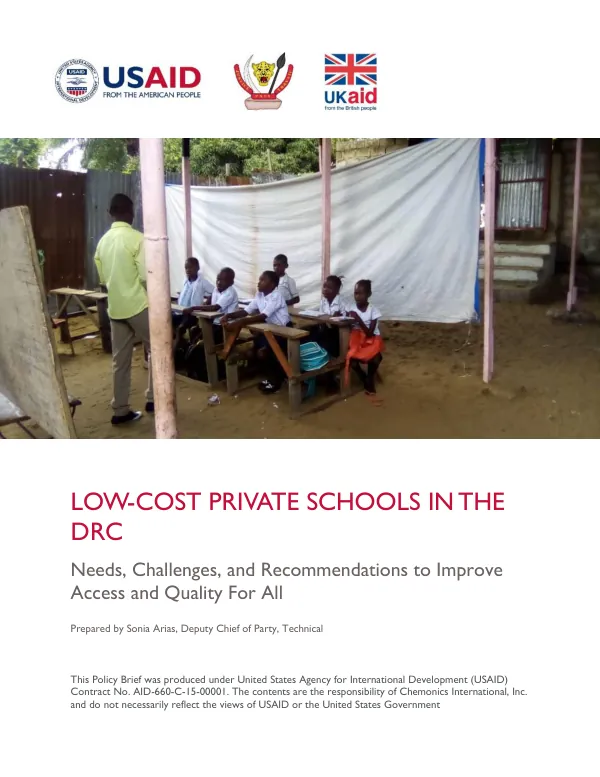
Low-Cost Private Schools in the DRC: Needs, Challenges, and Recommendations to Improve Access and Quality for All
Open record 2019
2019USAID DEC