USAID DEC
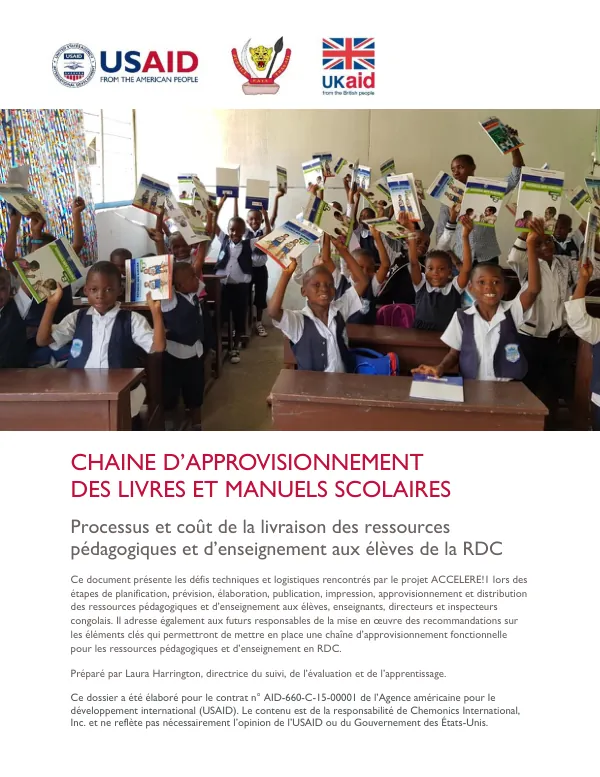
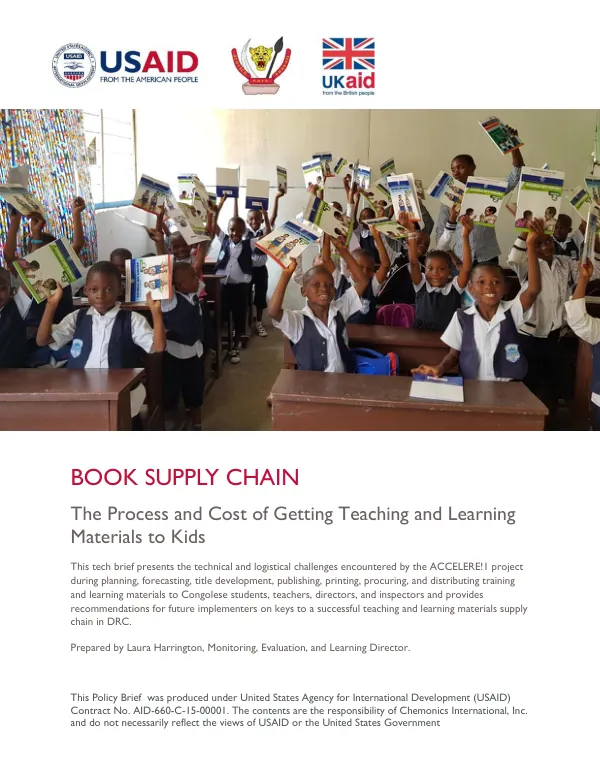
Book Supply Chain: The Process and Cost of Getting Teaching and Learning Materials to Kids
Sign inCHEMONICS
Book Supply Chain: The Process and Cost of Getting Teaching and Learning Materials to Kids
The ACCELERE!1 project aimed to improve educational outcomes for girls and boys in the Democratic Republic of Congo (DRC) through improved teaching and learning in national languages and French, reduced barriers to education, and increased transparency of school governance structures.
2020 · 7 pages
Sign in to readA free account is required to download.
Abstract
Funded by USAID and UK Aid, the project targeted nearly 250,000 students, teachers, and directors in the 2018-2019 school year. The DRC's infrastructure and environmental challenges posed significant obstacles to delivering teaching and learning materials (TLMs) to students and teachers. With fewer than 2,548 miles of paved roads across its 905,400 square miles, the country's vast size and limited transportation network made it difficult to transport materials to remote areas. The project's fixed timelines, which condensed development, testing, printing, delivery, training, and distribution to a year, further complicated the process. The ACCELERE!1 project applied supply chain principles and processes adapted for the education sector to overcome these challenges. A dedicated Supply Chain Manager was allocated to direct, coordinate, and systematize end-to-end operations and communications. The project established an in-house TLM Task Force, led by the Deputy Chief of Party for Technical, which reviewed timelines and requested input needed to execute planned next steps. Standardization of tools, terms, events, and tasks improved supply chain delivery. Critical standardized documents and tools included a list of book titles, delivery package, school lists, and delivery receipts. These streamlined tools facilitated the development of delivery plans and A!1 delivery receipt. Supply chain forecasting was also a key factor in supply chain effectiveness, with the TLM Task Force setting book delivery windows and working backwards to develop an implementation plan. The project used multiple ports of entry to position books closer to the end user and employed multiple transit methods based on best available transit routes. For the 2018-2019 school year, Kiswahili language books printed in India were shipped to Dar es Salam, Tanzania, and traveled overland to Lubumbashi, Goma, and Bukavu, where Kiswahili schools are located. A!1 developed and refined its pick and pack approach to preparing TLMs for delivery, training staff and day laborers to pull the necessary quantities of each title by training site, then box and label them. The project's use of pop-up distribution centers also improved delivery time and reduced the potential for materials to go missing. By positioning books closer to the end user and using multiple transit methods, the project was able to deliver TLMs to remote areas in a timely and efficient manner. The ACCELERE!1 project's application of supply chain principles and processes demonstrated innovation and the practical implementation of USAID's approach to delivering TLMs.
Related documents