USAID
M&E Guidance Series: Target Setting for Reducing the Prevalence of Poverty
The U.S.
2013 · 5 pages
Sign in to readA free account is required to download.
Abstract
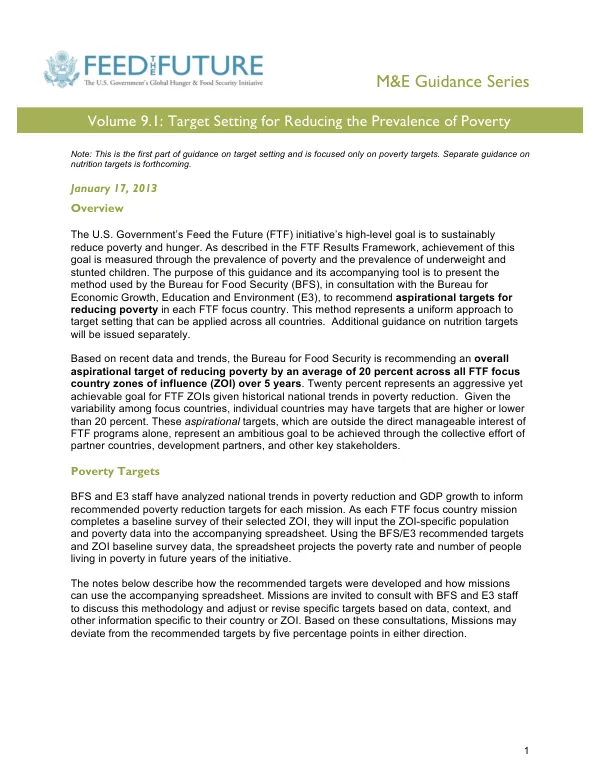
Government's Feed the Future (FTF) initiative aims to sustainably reduce poverty and hunger. The initiative's high-level goal is measured through the prevalence of poverty and the prevalence of underweight and stunted children. The FTF Results Framework outlines the achievement of this goal, which is to be measured through the prevalence of poverty and the prevalence of underweight and stunted children. The Bureau for Food Security (BFS) and the Bureau for Economic Growth, Education and Environment (E3) have developed a uniform approach to target setting for reducing poverty in each FTF focus country. This approach is based on recent data and trends, and it recommends an overall aspirational target of reducing poverty by an average of 20 percent across all FTF focus country zones of influence (ZOI) over 5 years. This target is considered aggressive yet achievable given historical national trends in poverty reduction. The poverty targets recommended by BFS and E3 were informed by two factors: one based on poverty and the other based on GDP growth. Factor 1 compares the actual annual percentage point reduction in the national poverty rate between the last two available data points in each country with the targeted annual percentage point reduction in the poverty prevalence that would be required to meet the five-year 20 percent reduction target. Factor 2 compares the required national GDP growth rate needed to meet the targeted five-year 20 percent poverty reduction target with projected national GDP growth rates. The two factors were used to inform the BFS/E3 recommended targets based on the best available evidence of poverty and growth at a national level. Higher targets were recommended for countries for which there is greater confidence in achieving significant results given the country's direction and momentum. The recommended targets are shown in Table 1 below. Table 1: BFS/E3 Recommended Poverty Targets | Country | Recommended Target | | --- | --- | | Country A | 30% | | Country B | 25% | | Country C | 20% | The accompanying Microsoft Excel spreadsheet is a tool to calculate and adjust country-specific targets. It includes the calculations supporting these recommended five-year poverty reduction targets. Each of the tabs, or worksheets, is described below. The Poverty Targets worksheet provides a summary of poverty reduction targets and can be modified with ZOI-specific baseline data. The FTF initiative began in 2010, and the baseline year for these targets will be 2012, with midterm and final years being 2015 and 2017, respectively. The required national GDP growth rate was compared with projected GDP growth rates for 2012 to 2017. The required level of per-capita GDP growth to meet the target was calculated based on each country's elasticity of poverty reduction. The elasticity of poverty reduction is the percentage reduction in the poverty rate that will result if per capita consumption increases by 1 percent. For the purposes of this model, the elasticity is used to estimate the effect of GDP growth on poverty reduction. The required national GDP growth rate was then compared with projected GDP growth rates for 2012 to 2017. The poverty targets recommended by BFS and E3 are based on national, country-wide data. After baseline data are collected specific to a ZOI, missions are invited to consult with BFS and E3 staff to adjust or revise targets based on information specific to their country or ZOI. For example, if a mission has data showing that poverty trends have declined faster in the ZOI in recent years compared with national rates, they may wish to consult with BFS/E3 to possibly select a more aggressive target than the recommendations.
Related documents