USAID
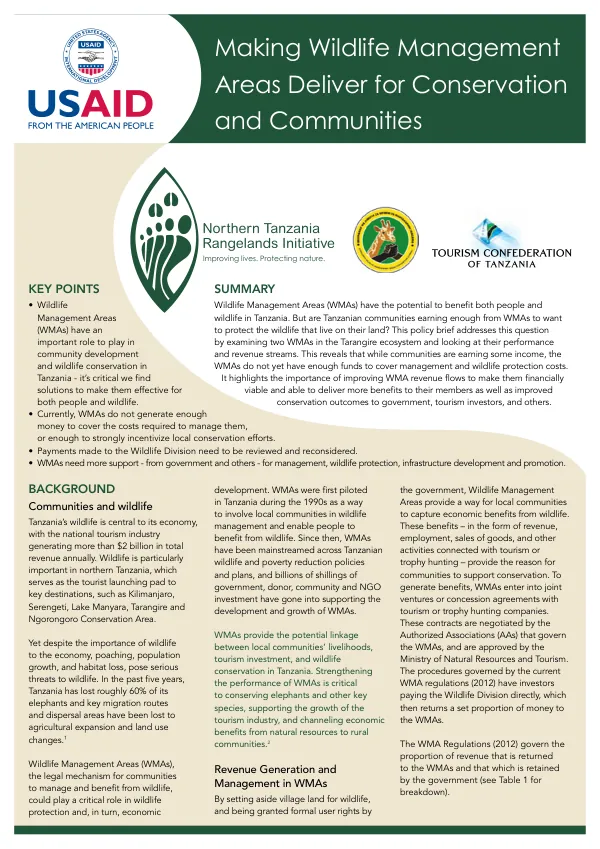
Making Wildlife Management Areas Deliver for Conservation and Communities
Wildlife Management Areas (WMAs) play a critical role in community development and wildlife conservation in Tanzania.
2016 · 4 pages
Sign in to readA free account is required to download.
Abstract
WMAs were first piloted in Tanzania during the 1990s as a way to involve local communities in wildlife management and enable people to benefit from wildlife. Since then, WMAs have been mainstreamed across Tanzanian wildlife and poverty reduction policies and plans, with billions of shillings of government, donor, community, and NGO investment supporting their development and growth. The main purpose of WMAs is to provide a linkage between local communities' livelihoods, tourism investment, and wildlife conservation in Tanzania. Strengthening the performance of WMAs is critical to conserving elephants and other key species, supporting the growth of the tourism industry, and channeling economic benefits from natural resources to rural communities. WMAs provide a way for local communities to capture economic benefits from wildlife, including revenue, employment, sales of goods, and other activities connected with tourism or trophy hunting. In Tanzania, WMAs enter into joint ventures or concession agreements with tourism or trophy hunting companies to generate benefits. These contracts are negotiated by the Authorized Associations (AAs) that govern the WMAs and are approved by the Ministry of Natural Resources and Tourism. The procedures governed by the current WMA regulations (2012) have investors paying the Wildlife Division directly, which then returns a set proportion of money to the WMAs. The WMA Regulations (2012) govern the proportion of revenue that is returned to the WMAs and that which is retained by the government. Under current regulations, WMAs are entitled to roughly 60-65% of the gross revenue from investment contracts in the WMAs. The revenue is then split between the WMA itself, used by the AA for management purposes, and the WMA member villages. Essentially, the WMA member villages are legally entitled to 50% of the revenue paid to the WMA, which leaves the remaining 50% for use by the AA for managing the WMA, including all management, resource protection, and governance functions. Protecting wildlife, particularly species such as elephants, is costly and includes management, anti-poaching activities, and governance costs. In Enduiment WMA, anti-poaching measures supported by Honeyguide and Big Life essentially eliminated a serious elephant poaching problem, but at a cost of roughly $250,000 annually, or about $175 per km2. The Performance and Viability of WMAs in Northern Tanzania highlights the importance of improving WMA revenue flows to make them financially viable and able to deliver more benefits to their members as well as improved conservation outcomes to government, tourism investors, and others. Randilen WMA, covering 312 km2 across eight villages in Monduli District, is home to 16,000 residents who are mostly pastoralist and agro-pastoralists. Randilen borders Tarangire National Park and is a critical habitat for northern Tanzania's largest elephant population, helping to attract tourists who pay more than $4 million in park fees to Tarangire every year. However, Randilen is not able to cover its management costs on its own, currently able to cover only around 30% of what it actually needs to effectively manage and protect its area. Makame WMA, located in Kiteto District and lying to the southeast of Tarangire National Park, covering 3,800 km2, is about 45% larger than all of Tarangire National Park. Makame WMA covers a critical stretch of habitat for wildlife, as historically about 400-500 elephants lived for most of the year in the Makame area, moving into southernmost Tarangire National Park only during the dry season. Makame WMA depends mainly on trophy hunting contracts and revenue, with trophy hunting revenue increasing sharply in 2014/15 after the Makame WMA was able to tender four hunting blocks and signed two contracts with a hunting operator, earning $117,077 that year.