CAROLINA POPULATION CENTER AT THE UNIVERSITY OF NORTH CAROLINA AT CHAPEL HILL
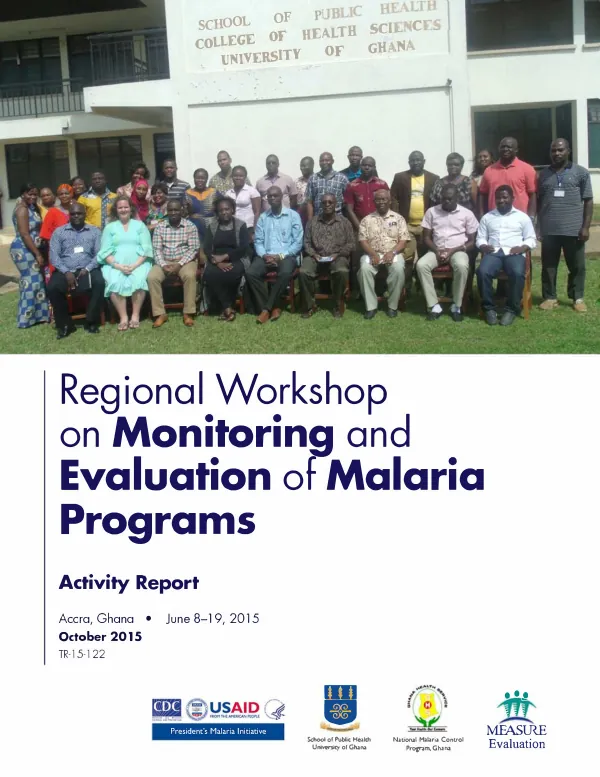
Malaria Control Programs Building Capacity through Regional Workshops
Malaria control programs in sub-Saharan Africa have received increased funding, necessitating strong information system support to inform program planning.
2014 · 3 pages
Sign in to readA free account is required to download.
Abstract
In response, MEASURE Evaluation and implementing partners, Centre de Recherche en Santé de Nouna (CRSN), Burkina Faso, and University of Ghana School of Public Health (UGSPH), Ghana, implemented regional Anglophone and Francophone workshops from 2010 to 2014 to strengthen capacity in the monitoring and evaluation (M&E) of malaria programs. The workshops aimed to provide participants with fundamental concepts and practical approaches to M&E of malaria programs, discuss programmatic applications of main tools and data systems used to monitor and evaluate malaria programs, and provide a venue for participants to share and learn from other country experiences to strengthen their M&E systems. The target audience included staff from National Malaria Control Programs, nongovernmental organizations, and donor personnel with a professional interest in M&E of malaria control programs. The workshops employed a variety of teaching methods, including participant knowledge assessments, plenary sessions, discussions, continuous workshop evaluation, group project work, data analysis, and field visits. Group work was a key component of the course, with participants developing an M&E plan focused on a specific malaria control intervention. The course content included an overview of malaria in sub-Saharan Africa, using data for decision making, introduction to M&E concepts, developing M&E plans, M&E frameworks, M&E indicators, M&E data sources, impact evaluation, data analysis, interpretation, and presentation. Between 2010 and 2014, 400 applications were received, and 181 participants completed the workshops. The workshops were held at the University of Ghana, School of Public Health in Accra, Ghana, and the University of Ouagadougou, School of Medicine in Ouagadougou, Burkina Faso. The curriculum included topics such as M&E frameworks, M&E indicators, and M&E data sources, as well as impact evaluation and data analysis. The workshops generated demand for country-focused trainings, with 50 participants trained in Kenya in 2011 and 27 in the Democratic Republic of Congo in 2013. Additional country-focused trainings are currently under discussion in Tanzania and Liberia. Many alumni have become facilitators for country-focused workshops. MEASURE Evaluation will assess the effect of these workshops on national malaria information systems and perform a malaria M&E capacity needs assessment. The curriculum will be redesigned to include tracks that allow participants to pursue M&E topics most relevant to their individual and country needs. Tracks will be chosen based on the results from the needs assessment. Country workshops will be organized on demand. The workshops have shown a relative improvement in knowledge per individual, with an increase of 22.0% in 2011, 34.6% in 2012, 34.5% in 2013, and 48.7% in 2014. The workshops have also helped individuals in their immediate work, with participants reporting that they were able to apply the knowledge and skills learned in the workshop to their jobs.