MINISTRY OF HEALTH
Malaria in Pregnancy Country Profile: Benin
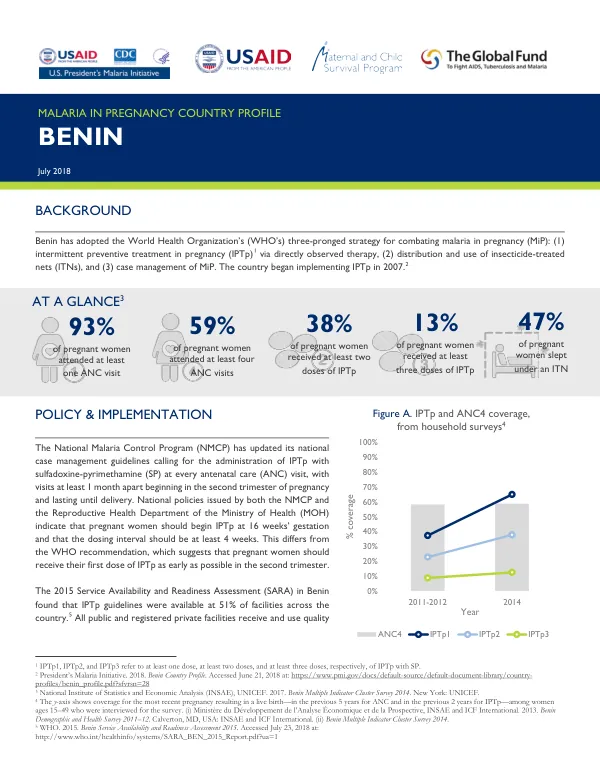
The World Health Organization's (WHO) strategy for malaria in pregnancy (MiP) is a three-pronged approach that includes intermittent preventive treatment in pregnancy (IPTp), distribution and use of insecticide-treated nets (ITNs), and case management of malaria during pregnancy.
2018 · 2 pages
Sign in to readA free account is required to download.
Abstract
Benin has adopted this strategy, with the National Malaria Control Program (NMCP) updating its case management guidelines to include the administration of IPTp via directly observed therapy (DOT) at every antenatal care (ANC) visit, starting from the second trimester. The NMCP and the Ministry of Health (MOH) have issued national policies indicating that pregnant women should begin IPTp at 16 weeks' gestation and that the dosing interval should be at least 4 weeks. However, the WHO recommends that pregnant women should receive their first dose of IPTp as early as possible in the second trimester. The 2015 Service Availability and Readiness Assessment (SARA) found that IPTp guidelines were available at 51% of facilities across the country. Benin has made progress in increasing IPTp coverage, with 82% of facilities providing IPTp services. However, there are still gaps in service provider readiness and missed opportunities to administer IPTp. The MOH has introduced outreach services, including IPTp, in low-coverage health zones, and the NMCP has updated its ANC registers to reflect the number of IPTp doses administered. The Health Management Information System (HMIS) reports on IPTp1, IPTp2, and IPTp3, as well as the number of ITNs distributed during ANC services. The country is working to improve SP supply management at the health facility level, with 86% of health facilities having SP in stock for IPTp. Benin has a functioning MiP Technical Working Group to ensure coordination between malaria services and reproductive health services. The country has also made progress in increasing ANC coverage, with 93% of pregnant women attending at least one ANC visit. The Benin Demographic and Health Survey 2011-12 found that 59% of pregnant women attended at least four ANC visits, and 47% of pregnant women slept under an ITN. However, there are still challenges in increasing IPTp coverage, particularly in rural areas, where 8% of pregnant women received at least three doses of IPTp. The country must address these gaps to achieve the NMCP's 2015 target of 100% IPTp coverage.