USAID DEC
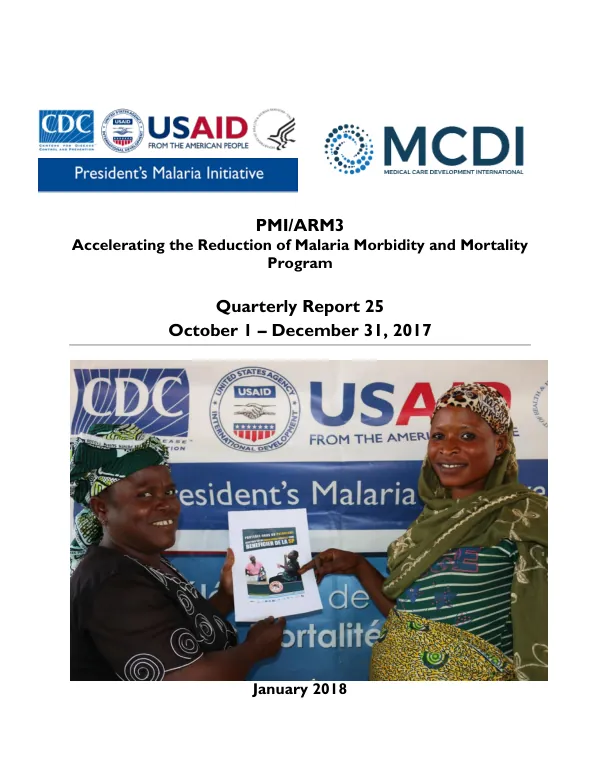
Accelerating the Reduction of Malaria Morbidity and Mortality Program (ARM3) Quarterly Report 25
Sign inMEDICAL CARE DEVELOPMENT INTERNATIONAL
Accelerating the Reduction of Malaria Morbidity and Mortality Program (ARM3) Quarterly Report 25
Strengthening the effectiveness of national malaria prevention interventions is a key objective of the Accelerating the Reduction of Malaria Morbidity and Mortality Program (ARM3).
2018 · 67 pages
Sign in to readA free account is required to download.
Abstract
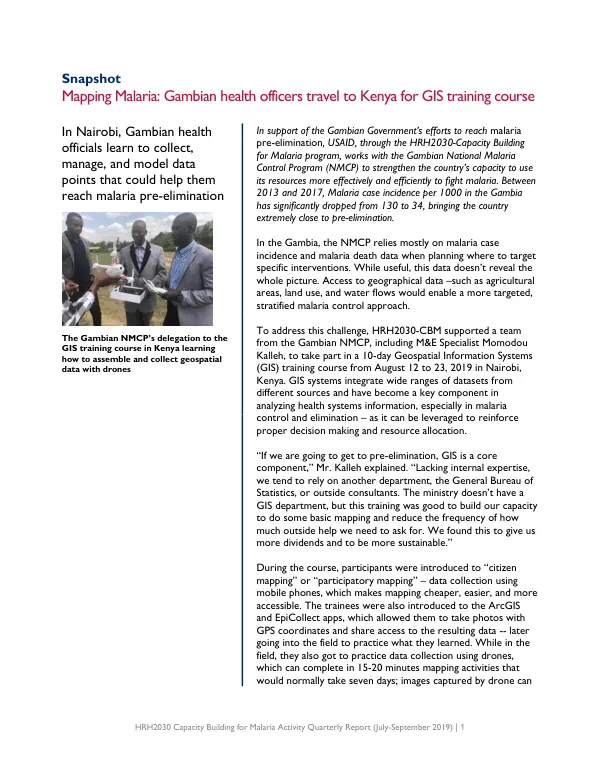
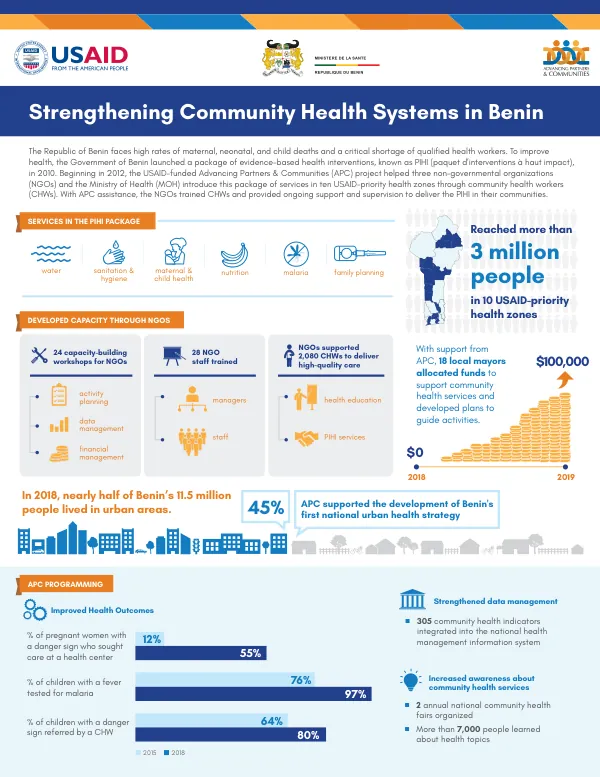
Technical assistance was provided to the National Malaria Control Program (NMCP) to integrate the revised SBCC strategy of the National SBCC Plan in collaboration with the GFATM and the CRS CATCH project. A new National Integrated Plan was developed, and post-training follow-up supervision of health workers on inter-personal communication in NBT, TCM, and 2KP Health Zones (HZs) of the Atacora Department was conducted. The coverage of intermittent preventive treatment during pregnancy (IPTp) per new national standards increased. A total of 1,060 out of 1,155 health facilities (HFs) submitted reports for July-September 2017. The IPTp2 coverage increased from 61.1% to 66.5% compared to the previous quarter. The program also participated in the mass LLIN distribution campaign by the NMCP in the center and southern DDS in Benin. A total of 2,003,723 households were inventoried, with an average size of 3-6 persons. Of these households, 1,921,708 received LLINs, representing 96.9% of the total inventoried. A total of 4,363,460 LLINs were distributed, representing 96.4% of the population inventoried. The program provided technical and financial support to the NMCP to review, update, and validate IPT, LLIN, and prompt-seeking messages. Jointly with the NMCP, the program supervised data collection as part of the baseline evaluation of the LLIN distribution in prioritized areas. The program also finalized the updated OTS database and trained NMCP lab technicians at the NMCP level to use this database. In collaboration with the NMCP, the program conducted a post-training follow-up of 22 private sector lab technicians trained in Y6. Technical and financial support was provided to the NMCP to develop a database on training for malaria, including a training plan for pre-service and in-service training of health workers in the public and private sectors. The program participated in a technical meeting for the introduction of injectable and rectal artesunate through HFs in Benin. Technical and financial support was provided to the NMCP to develop a database on training for malaria, including a training plan for pre-service and in-service training of health workers in the public and private sectors. The program also provided technical assistance to the NMCP to develop a database on training for malaria, including a training plan for pre-service and in-service training of health workers in the public and private sectors. The program improved the diagnostic capacity and use of diagnostic testing. The program finalized the updated OTS database and trained NMCP lab technicians at the NMCP level to use this database. In collaboration with the NMCP, the program conducted a post-training follow-up of 22 private sector lab technicians trained in Y6. Technical and financial support was provided to the NMCP to develop a database on training for malaria, including a training plan for pre-service and in-service training of health workers in the public and private sectors. The program improved integrated community case management. The program supported the DNSP to organize dissemination workshops of the National Community Health Policy and the National guidelines for monitoring and evaluation of the PIHI-COM for 112 local health authorities, health workers, and community facilitators of the communes of ALLADA, ZE, and TOFFO. The program participated in a workshop to review certain standards of PIHI-COM in order to obtain training modules for CHs and tools to report the implementation of PIHI-COM in urban and peri-urban areas. The program provided technical assistance to BUPDOS to organize a capacity-building for social health workers and community facilitators on post-training follow-up, supervision, and evaluation of CHs in the CBGH HZ. The program also provided technical and financial assistance to DDS Zou/Collines and the Cove-Zagnan-ouinhi (CoZo) and Savalou-Banté (SaBa) HZs for data collection through CHs group monitoring sessions. In collaboration with the NMCP and the NMCP, the program supervised CHs in 2 HZs (SaBa and CoZo) through monthly field visits. A total of 150 CHs were visited, and 97.65% (1,413/1,447) of children admitted for fever were tested for malaria, with 86.05% (1,216
Related documents