MOH
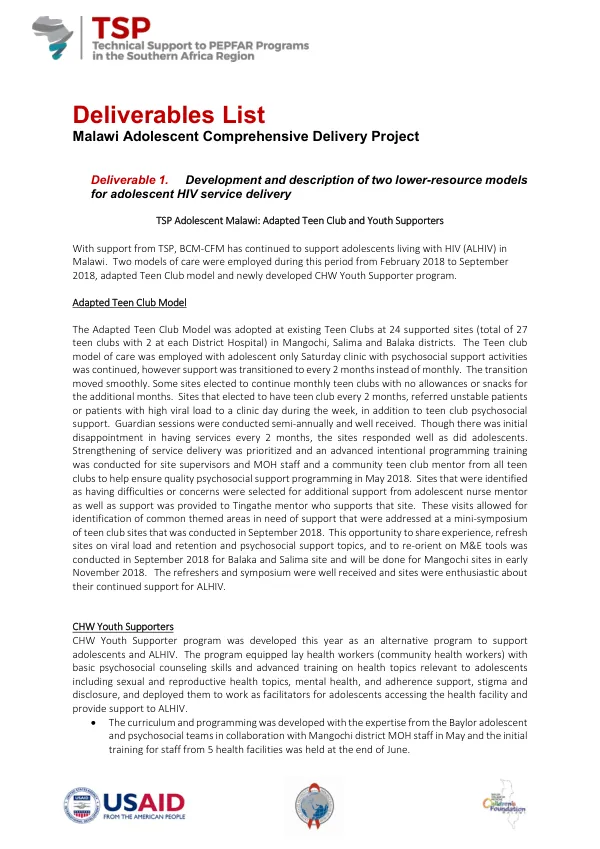
Malawi Adolescent Comprehensive Delivery Project Deliverables List
The Malawi Adolescent Comprehensive Delivery Project aimed to provide comprehensive services to adolescents living with HIV (ALHIV) in Malawi.
2019 · 358 pages
Sign in to readA free account is required to download.
Abstract
Two models of care were employed during this period: the Adapted Teen Club Model and the CHW Youth Supporter program. The Adapted Teen Club Model was adopted at 24 supported sites in Mangochi, Salima, and Balaka districts. The model involved adolescent-only Saturday clinics with psychosocial support activities, which were transitioned from monthly to every two months. Sites that continued with monthly teen clubs provided additional support to unstable patients or those with high viral loads. Guardian sessions were conducted semi-annually and well received by the sites and adolescents. An advanced intentional programming training was conducted for site supervisors and MOH staff to ensure quality psychosocial support programming. The CHW Youth Supporter program was developed as an alternative program to support adolescents and ALHIV. The program equipped lay health workers with basic psychosocial counseling skills and advanced training on health topics relevant to adolescents, including sexual and reproductive health, mental health, and adherence support. Five facilities without current teen clubs were selected as pilot sites, and each facility selected two youthful CHWs and one youthful MOH staff member who attended a one-week training and one-week attachment at Baylor COE. The CHW Youth Supporters provided 1:1 psychosocial support focusing on adherence and barriers to adherence during regular ART clinics. They also linked patients to care, followed individual patient adherence, tracked patients with missed appointments, and ensured viral load testing was done. The program was well received, and sites were enthusiastic about their continued support for ALHIV. A standard Terms of Reference (TOR) for the CHW Youth Supporter program was developed. The TOR outlined the roles and responsibilities of the Youth Supporters, including PITC/OPD screening, linkage, adherence support for ART, disclosure support, and viral load monitoring. The Youth Supporters were expected to provide daily and weekly services, including screening adolescents for HIV testing, offering counseling to those with positive results, and linking them to ART. They were also responsible for providing adherence support, disclosure support, and viral load monitoring. The TOR emphasized the importance of the Youth Supporters in advocating for adolescents and ensuring they receive the services they need. The program aimed to provide comprehensive support to adolescents living with HIV, including psychosocial support, adherence support, and linkage to care. The CHW Youth Supporters played a crucial role in ensuring that adolescents received the necessary support to manage their HIV status and maintain adherence to treatment.
Related documents
![Measurement Approaches for Effective Coverage Estimation [MR31]](https://covers.devme.ai/gen/138167.webp)