USAID DEC
HIV Service Use Among Men Living With HIV in Malawi: Findings from DREAMS Implementation Science Research
Sign inPOPULATION COUNCIL
HIV Service Use Among Men Living With HIV in Malawi: Findings from DREAMS Implementation Science Research
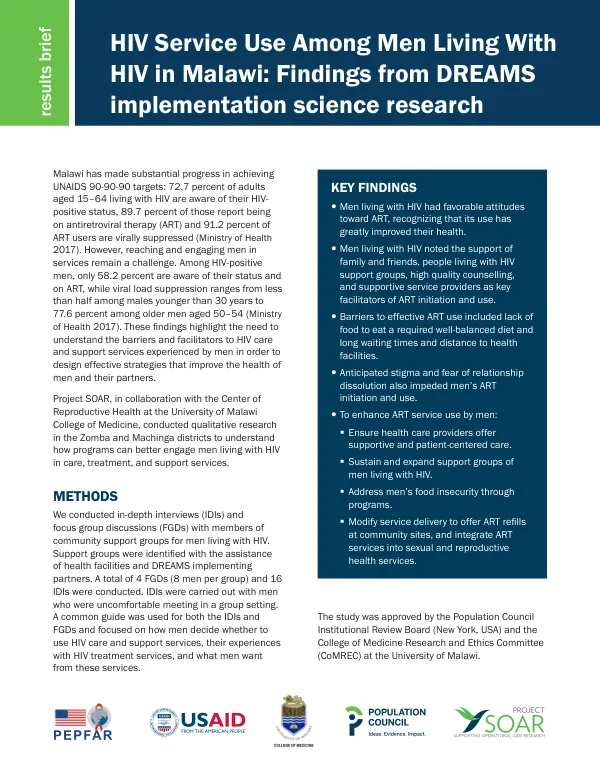
Malawi has made substantial progress in achieving UNAIDS 90-90-90 targets, with 72.7 percent of adults aged 15–64 living with HIV aware of their HIV-positive status, 89.7 percent of those reporting being on antiretroviral therapy (ART), and 91.2 percent of ART users virally suppressed.
2021 · 4 pages
Sign in to readA free account is required to download.
Abstract
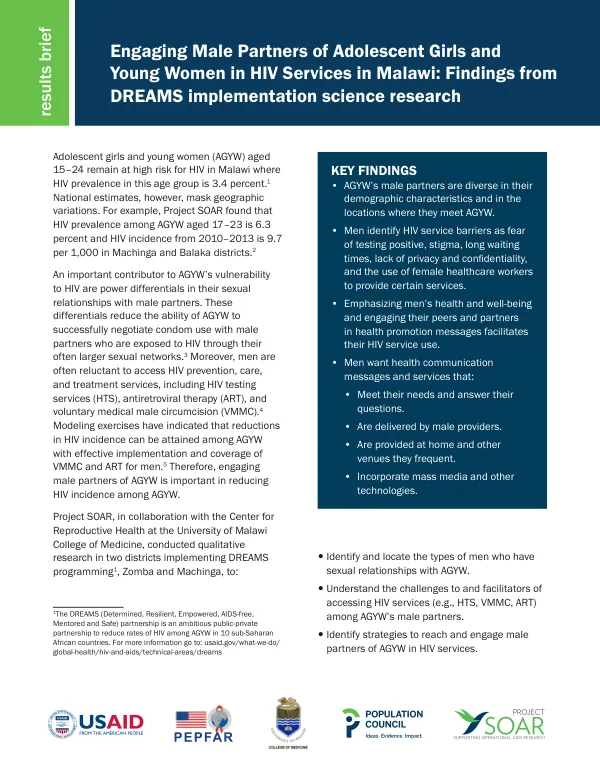
However, reaching and engaging men in services remains a challenge, with only 58.2 percent of HIV-positive men aware of their status and on ART. Project SOAR, in collaboration with the Center of Reproductive Health at the University of Malawi College of Medicine, conducted qualitative research in the Zomba and Machinga districts to understand how programs can better engage men living with HIV in care, treatment, and support services. The study involved in-depth interviews and focus group discussions with members of community support groups for men living with HIV. A total of 4 focus group discussions and 16 in-depth interviews were conducted, with a common guide used for both methods. The study found that men living with HIV had favorable attitudes toward ART, recognizing that its use has greatly improved their health. Men noted the support of family and friends, people living with HIV support groups, high-quality counseling, and supportive service providers as key facilitators of ART initiation and use. Barriers to effective ART use included lack of food to eat a well-balanced diet and long waiting times and distance to health facilities. Anticipated stigma and fear of relationship dissolution also impeded men's ART initiation and use. To enhance ART service use by men, the study recommended ensuring healthcare providers offer supportive and patient-centered care, sustaining and expanding support groups of men living with HIV, addressing men's food insecurity through programs, and modifying service delivery to offer ART refills at community sites and integrate ART services into sexual and reproductive health services.
Related documents