USAID DEC
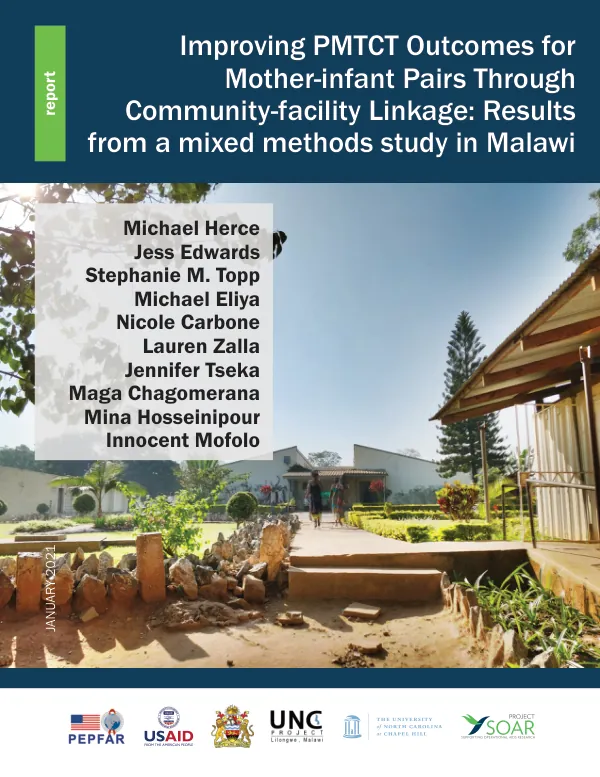
Improving PMTCT outcomes for mother-infant pairs through community-facility linkage: Results from a mixed methods study in Malawi
Sign inELIZABETH GLASER PEDIATRIC AIDS FOUNDATION
Improving PMTCT outcomes for mother-infant pairs through community-facility linkage: Results from a mixed methods study in Malawi
The mixed methods study in Malawi aimed to improve PMTCT outcomes for mother-infant pairs through community-facility linkage.
2021 · 56 pages
Sign in to readA free account is required to download.
Abstract
The study was conducted in collaboration with the Malawi Ministry of Health, U.S. President's Emergency Plan for AIDS Relief, U.S. Agency for International Development, Population Council, UNICEF-Malawi, Lighthouse Trust, Baylor Tingathe, and Partners In Health. The study was led by investigators from the University of North Carolina, UNC Project-Malawi, and the Malawi Ministry of Health. The study employed a mixed methods approach, combining both qualitative and quantitative data collection and analysis methods. The qualitative findings highlighted the major characteristics of three community-facility linkage models, including the mothers2mothers program, the Baylor program, and the Dignitas International expert client model. These models aimed to empower mothers living with HIV, improve PMTCT, EID, and pediatric HIV care and treatment services, and increase community involvement in healthcare delivery. The quantitative findings presented participant flow, characteristics of the full and nested cohorts, maternal outcomes, infant outcomes, and CFL model components. The study found that maternal outcomes improved in the full and nested cohorts, with a significant increase in the proportion of mothers receiving antiretroviral therapy and a decrease in the proportion of mothers experiencing adverse pregnancy outcomes. Infant outcomes also improved, with a significant decrease in the proportion of infants born with HIV and a decrease in infant mortality rates. The CFL model components included community health worker training, facility-based care, and community-based care. The study found that the CFL models were effective in improving PMTCT outcomes, particularly when combined with facility-based care. The study also highlighted the importance of community health worker training and community-based care in improving PMTCT outcomes. The study's findings have implications for the implementation of community-facility linkage models in Malawi and other countries. The study suggests that CFL models can be effective in improving PMTCT outcomes, particularly when combined with facility-based care. The study also highlights the importance of community health worker training and community-based care in improving PMTCT outcomes. The study's conclusions and recommendations emphasize the need for continued investment in community-facility linkage models and the importance of community health worker training and community-based care in improving PMTCT outcomes. The study also highlights the need for further research on the effectiveness of CFL models in improving PMTCT outcomes and the importance of monitoring and evaluation to ensure the sustainability of CFL models. The study's results have been disseminated to stakeholders, including the Malawi Ministry of Health, U.S. President's Emergency Plan for AIDS Relief, U.S. Agency for International Development, Population Council, UNICEF-Malawi, Lighthouse Trust, Baylor Tingathe, and Partners In Health. The study's findings have also been presented at international conferences and published in peer-reviewed journals. The study's methodology included site assessments, sample data collection, data analyses, and results dissemination. The study was conducted in collaboration with the Malawi Ministry of Health, U.S. President's Emergency Plan for AIDS Relief, U.S. Agency for International Development, Population Council, UNICEF-Malawi, Lighthouse Trust, Baylor Tingathe, and Partners In Health. The study's results have been used to inform policy and program decisions in Malawi and other countries.