USAID DEC
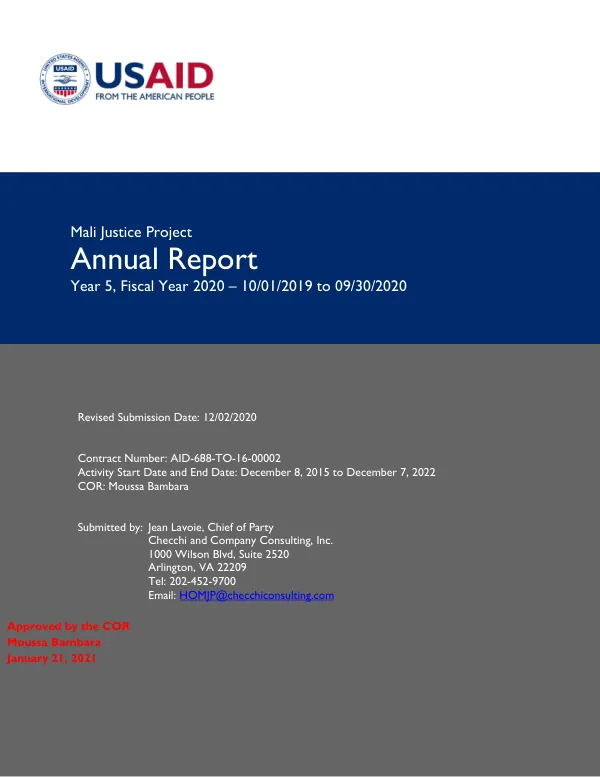
Mali Justice Project Annual Report Year 5, Fiscal Year 2020 – 10/01/2019 to 09/30/2020
Sign inCHECCHI AND COMPANY, CONSULTING, INC.
Mali Justice Project Annual Report Year 5, Fiscal Year 2020 – 10/01/2019 to 09/30/2020
The Mali Justice Project (MJP) is a five-year initiative aimed at enhancing justice service delivery and efficiency of justice sector institutions in Mali.
2020 · 120 pages
Sign in to readA free account is required to download.
Abstract
The project began on December 8, 2015, and is set to conclude on December 7, 2022. MJP is funded by the United States Agency for International Development (USAID) with a total estimated cost of $31,880,958. In Year 5, MJP's activities were significantly impacted by the global outbreak of the coronavirus and a political crisis that led to the ousting of President Ibrahim Boubacar Keita's government through a coup d'état on August 18, 2020. In response to the COVID-19 pandemic, the government of Mali issued a decree requiring individuals who had traveled to countries severely affected by the outbreak to undergo a mandatory 14-day self-quarantine period upon arrival. This measure affected many MJP activities, particularly those requiring large gatherings of people. MJP's focus in Year 5 was on supporting the implementation of legislative and institutional changes awaiting final approval from the relevant authorities. The project also built the capacity of stakeholders, particularly through mentoring and training of trainers, to sustain the progress made thus far. MJP trained DNAJ officials in monitoring, control, and evaluation of courts to improve their performance. A joint MJP-DNAJ test mission was conducted at the Koulikoro High Court to verify the relevance of the tools proposed by the assessment guide. MJP also assisted the DNAJS in steering the work of the Standing Legislative Committee (CPL), which has effectively completed the examination process of the preliminary draft Criminal Procedure Code and Criminal Code. The project provided support for the training of heads of courts and prosecution services, chief clerks of courts and tribunals, as well as equipment-accountants, both in public procurement and the development of annual performance plans. The objective is to improve the management of public resources allocated to the justice sector and strengthen accountability in the management of these resources. MJP is also making its interventions through a partnership with the National Institute for Judicial Training (INFJ), which hosted conferences of heads of courts and prosecution services on themes relating to the role of the Public Prosecutor's department in the restoration of State authority. The project has strengthened the capacities of Mali's Chief Clerks and clerks of the courts in archiving at clerks' offices, a preliminary step in the computerization of civil and criminal chains. In the field of modernization of Human Resources management of the Ministry of Justice and Human Rights, the most significant developments in Year 5 were the current development of a Human Resource Information System (HRIS) and the implementation of a performance-based management system. The project has also supported the development of a new organizational structure for the Ministry of Justice and Human Rights, which aims to improve the efficiency and effectiveness of the ministry's operations. MJP has also made significant progress in promoting gender equality and combating gender-based violence (GBV) in the justice sector. The project has supported the establishment of a GBV unit within the Ministry of Justice and Human Rights, which aims to provide support and services to victims of GBV. MJP has also trained judges, prosecutors, and other justice sector officials on GBV and provided support for the development of GBV-related policies and procedures. In addition, MJP has made significant progress in promoting access to justice for marginalized communities, particularly women and children. The project has supported the establishment of a network of community-based justice centers, which provide access to justice services for marginalized communities. MJP has also trained community-based justice center staff on GBV and provided support for the development of GBV-related policies and procedures. Overall, MJP has made significant progress in enhancing justice service delivery and efficiency of justice sector institutions in Mali. The project has supported the implementation of legislative and institutional changes, built the capacity of stakeholders, and promoted gender equality and access to justice for marginalized communities.