USAID DEC
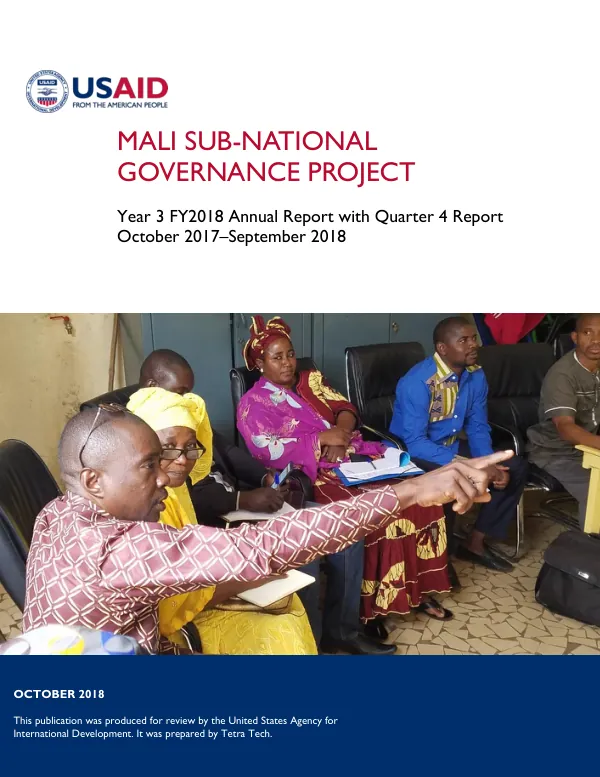
Mali Sub-National Governance Project Year 3 FY2018 Annual Report with Quarter 4 Report
Sign inTETRA TECH
Mali Sub-National Governance Project Year 3 FY2018 Annual Report with Quarter 4 Report
The Mali Sub-National Governance Project (SNGP) is a USAID-funded initiative aimed at strengthening national and subnational public financial management in Mali.
2018 · 82 pages
Sign in to readA free account is required to download.
Abstract
The project's primary objective is to enhance the capacity of national and regional governments, as well as women, in budget planning, implementation, and reporting. The project's scope encompasses three key components: strengthening national and subnational public financial management, improving coordination and communication between national and subnational government and civil society, and conducting performance audits that meet international standards. Component One focuses on strengthening national and subnational public financial management. The project has achieved several outcomes, including increased capacity of national and regional governments, and women, in budget planning, implementation, and reporting. Additionally, the project has increased capacity, including women, in financial management at national and regional levels, improved information flow between Bamako and the regions, and enhanced regional actors' understanding of the rules, regulations, and laws governing their work. Furthermore, the project has improved the management of funds at the regional level, increased the quality of services delivered at the regional level, particularly for women, and generated increased revenue at the regional level. Component Two aims to improve coordination and communication between national and subnational government and civil society. The project has achieved several outcomes, including increased citizens' access to information on the national budget, including budget planning, allocation, and execution, disaggregated by gender. Additionally, the project has increased information sharing between government and civil society on matters related to the budget and decentralization, and improved coordination between national and regional government in planning, and regional and the communes, and regional and the circles, and circles and communes. The project has also increased citizens' awareness of decentralization reforms and the progress made by the government towards achieving its decentralization and fiscal goals. Component Three focuses on conducting performance audits that meet international standards. The project has achieved several outcomes, including the creation of a capable performance monitoring section within the Supreme Audit Institution (CGSP). The CGSP has met international standards for SAI, conducted regular performance monitoring, and made these reports publicly available. Additionally, the CGSP has improved its ability to monitor regional government entities, established a user-friendly website to store audit-related information, and conducted town hall meetings and press conferences to discuss audit findings. The project has also increased the knowledge and skills of SAI auditors in performance and risk-based audits, improved public disclosure of audit findings, and enhanced internal control systems at the national and regional levels. The project has also implemented gender-related activities aimed at increasing the capacity of national and regional governments, and women, in budget planning, implementation, and reporting. Additionally, the project has increased capacity, including women, in financial management at national and regional levels, and enhanced regional actors' understanding of the rules, regulations, and laws governing their work. The project's management plan outlines its operations and staffing, security and safety measures, general communications and outreach strategy, and monitoring and evaluation framework.