FEWS NET
Mali Summary of Market and Food Security Situational Analysis
The agricultural sector in Mali is facing significant challenges, with production and pasturage deficits leading to exceptionally high local cereal prices.
2012 · 4 pages
Sign in to readA free account is required to download.
Abstract
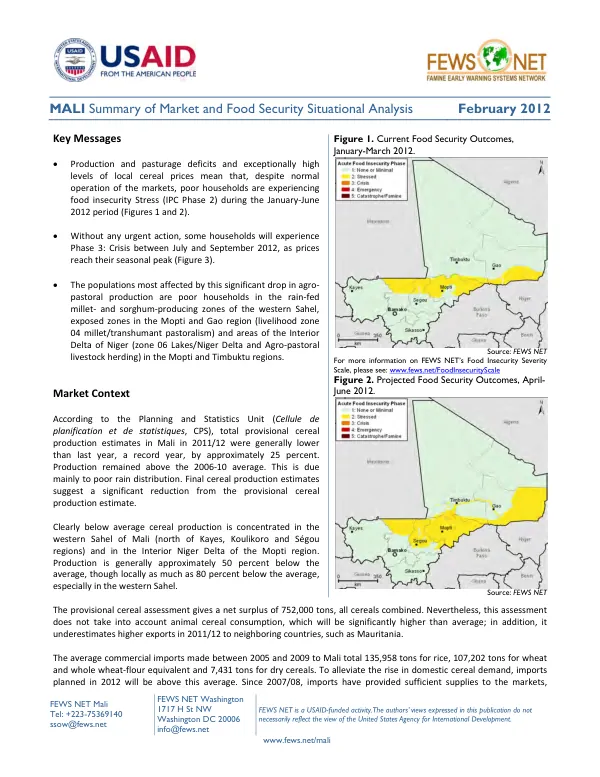
As a result, poor households are experiencing food insecurity, classified as Stress (IPC Phase 2) during the January-June 2012 period. Without urgent action, some households will experience Crisis (IPC Phase 3) between July and September 2012, as prices reach their seasonal peak. The populations most affected by this significant drop in agro-pastoral production are poor households in the rain-fed millet- and sorghum-producing zones of the western Sahel, exposed zones in the Mopti and Gao region, and areas of the Interior Delta of Niger in the Mopti and Timbuktu regions. These areas have experienced a 25% reduction in cereal production compared to the previous year, with production remaining above the 2006-10 average due to poor rain distribution. The average price of millet in January 2012 is between 50% and 80% higher than its relatively low level in January 2011 and the average for the last five years. Despite the general increase in the daily wage and income from other self-employment activities, this is not sufficient to increase both the quantity demanded of preferred cereals or the principal substitute (imported rice) and to cope with high prices, especially during the lean season between July-September. Household stocks in the most affected areas, which cover consumption needs for two or even three months in a normal year, are almost insignificant. In western Mali, especially in Kayes (zone 8), demand for community and household stocks was met by emigrants, meaning that demand for local cereals is currently higher than the average with a below-average supply level. Livestock markets (cattle, sheep, goats) are well supplied, with the supply of cattle higher than last year. However, animal body conditions will be affected by the lack of pastures, and prices will drop between April and June, affecting the incomes of pastoralists who do not have enough animals to sell and making their access to cereals more difficult than usual. The Government is resupplying the market with OPAM reserves, exempting commercial imports of cereals from taxes, and food assistance in millet, sorghum, and rice (35,000 tons of rice donated by Brazil). Mali has a food security program that all donors share and that is responsible for providing information and recommendations for action if necessary. The CSA (Food Security Commissariat) has a program to distribute almost 45,886 tons of cereals for free in the 104 towns classified as having "food difficulties" since December 2011. The populations most at risk of acute food insecurity are very poor and poor households who are both dependent on agricultural activities (facing a reduction of their own production and labor demand) and net consumers of cereals. They are concentrated in areas of rain-fed millet and sorghum cultivation in the western Sahel, exposed zones in the Mopti and Gao region, rice growing regions in the Mopti region Delta, and, to a lesser extent, in the Niger river valley in some places in the Mopti, Gao, and Timbuktu regions of zone 06 (Niger River Lake and Delta rice farming (agro-pastoral)).