MINISTRY OF HEALTH AND CHILD WELFARE
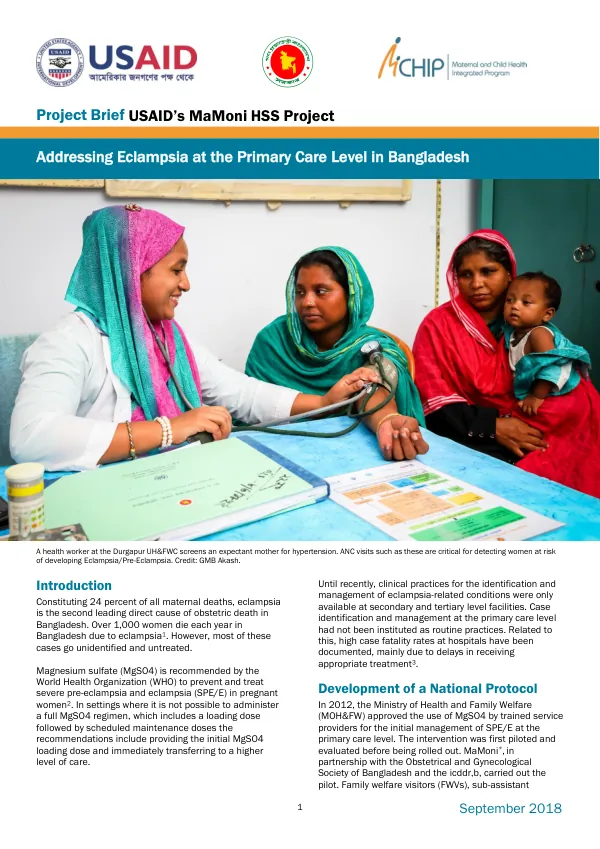
MaMoni Program: Addressing Eclampsia at the Primary Care Level in Bangladesh
The Ministry of Health and Family Welfare (MOH&FW) in Bangladesh approved the use of magnesium sulfate (MgSO4) by trained service providers for the initial management of severe pre-eclampsia and eclampsia at the primary care level in 2012.
2018 · 8 pages
Sign in to readA free account is required to download.
Abstract
The intervention was first piloted and evaluated before being rolled out. MaMoni, in partnership with the Obstetrical and Gynecological Society of Bangladesh and the icddr,b, carried out the pilot. Family welfare visitors (FWVs), sub-assistant community medical officers (SACMOs), and community skilled birth attendants (CSBAs) were trained to screen for severe pre-eclampsia and eclampsia and to provide a pre-referral loading dose of MgSO4. The National Technical Committee under the Directorate General of Family Planning approved FWVs and SACMOs to administer MgSO4 at the union-level facilities in 2015. The MOH&FW released an initial version of its Maternal Health Standard Operating Procedures with guidance on severe pre-eclampsia and eclampsia in 2016. The guidelines align with World Health Organization (WHO) recommendations, indicating that at union-level health facilities, women who present with severe pre-eclampsia or eclampsia are to receive an MgSO4 loading dose and be referred to a comprehensive emergency obstetric and newborn care (CEmONC) facility. MaMoni HSS Support to the MOH&FW began in 2015, with the USAID-funded MaMoni Health Systems Strengthening (HSS) project supporting the MOH&FW to implement the pilot. An initial 45 union health and family welfare centers (UH&FWCs) from across MaMoni HSS's four focus districts were selected for the intervention. The 45 facilities were chosen based on the following criteria: had relatively high antenatal care (ANC) coverage, were open 24 hours a day, had a referral facility at an accessible distance, and had satellite clinics with comparatively strong performance. MaMoni HSS's support consisted of conducting a baseline assessment, training providers, providing supplies, and establishing a system for documentation and reporting. The baseline assessment revealed that across the 6 months of data from all facilities, 21,726 pregnant women were seen for ANC, but only three PE cases and two eclampsia cases were identified, and none of the cases were treated with MgSO4. This indicated that the majority of PE, SPE, and eclampsia cases were not being identified or treated. Provider capacity-building was a key component of the intervention. In March 2016, MaMoni HSS and the Obstetrical and Gynecological Society of Bangladesh initiated training for community-level providers at UH&FWCs. Meetings were held in each district for district and upazila managers to orient them on the intervention. A national training of trainers was also held to form a group of district-level "master" trainers. This group replicated the training for FWVs, SACMOs, and paramedics as new facilities adopted the intervention. Service providers at secondary-level referral facilities also received an orientation on the intervention to prepare them to receive and manage the referred cases. Trainings were two days in duration and competency-based. The training modules prepared providers to check blood pressure and conduct a urine protein analysis at every antenatal, intranatal, and postnatal visit. Participants learned to identify cases of PE, SPE, and eclampsia based on elevated blood pressure, proteinuria, and the presence of at least one pregnancy danger sign. Providers learned to administer a single intramuscular injection of MgSO4 and refer identified SPE and eclampsia cases to the nearest CEmONC facility. By April 2018, 550 community-level providers from 197 UH&FWCs had been trained on PE, SPE, and eclampsia identification and management. Supplies for screening and treatment were also provided. Each provider received a blood pressure gauge and the pictorial algorithm for case identification and management. MgSO4 was provided by the project through the national supply chain. Urine test tubes and strips for testing albumin levels were already available at all primary care facilities through the existing supply chain. Service documentation and reporting were also established, with providers documenting services in MNCH registers that are part of the national health information system.
Related documents
Documents in this collection
 2018
2018USAID DEC
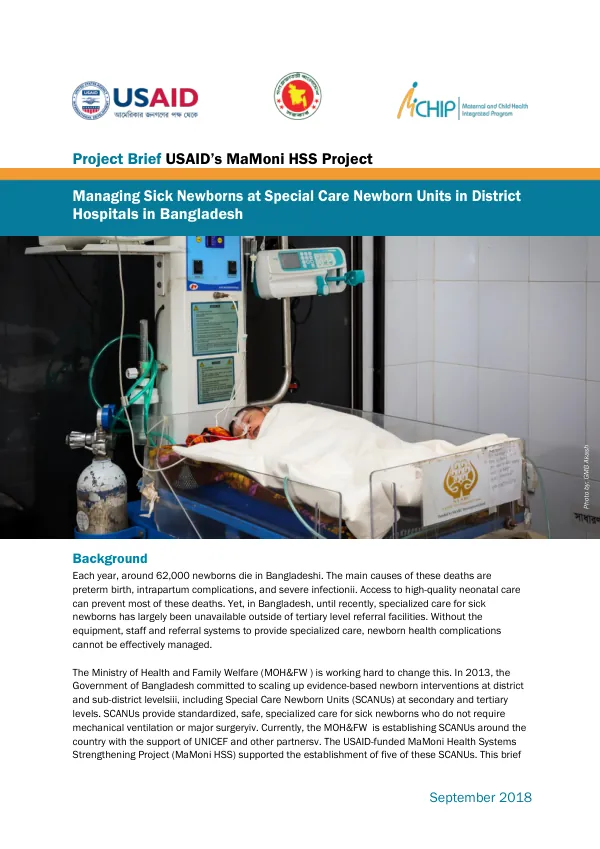
Project Brief USAID’s MaMoni HSS Project Managing Sick Newborns at Special Care Newborn Units in District Hospitals in Bangladesh
Open record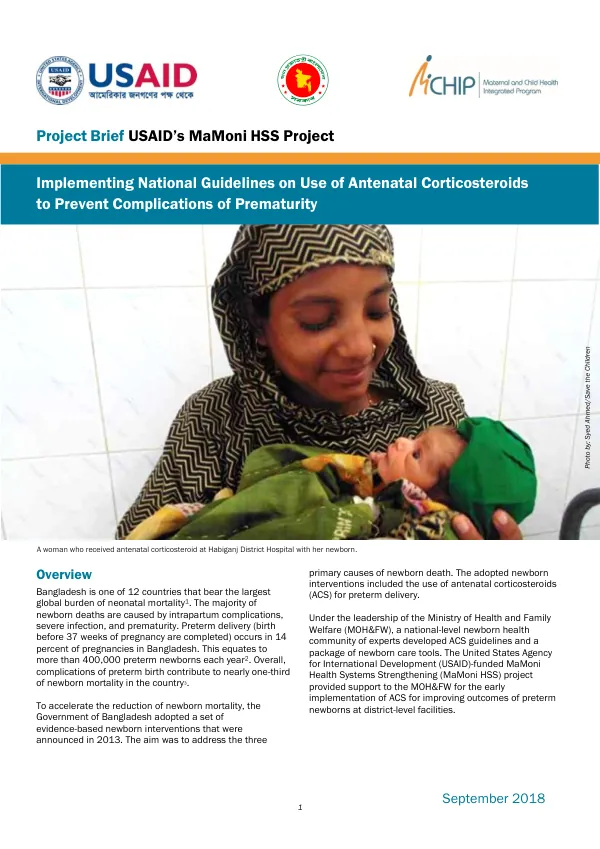 2018
2018USAID DEC
MaMoni Project Brief: Implementing National Guidelines on Use of Antenatal Corticosteroids to Prevent Complications of Prematurity
Open record