USAID DEC
Project Brief USAID’s MaMoni HSS Project Managing Sick Newborns at Special Care Newborn Units in District Hospitals in Bangladesh
Sign inMINISTRY OF HEALTH AND CHILD WELFARE
Project Brief USAID’s MaMoni HSS Project Managing Sick Newborns at Special Care Newborn Units in District Hospitals in Bangladesh
The MaMoni Health Systems Strengthening Project (MaMoni HSS) was a USAID-funded initiative aimed at improving newborn care in Bangladesh.
2018 · 12 pages
Sign in to readA free account is required to download.
Abstract
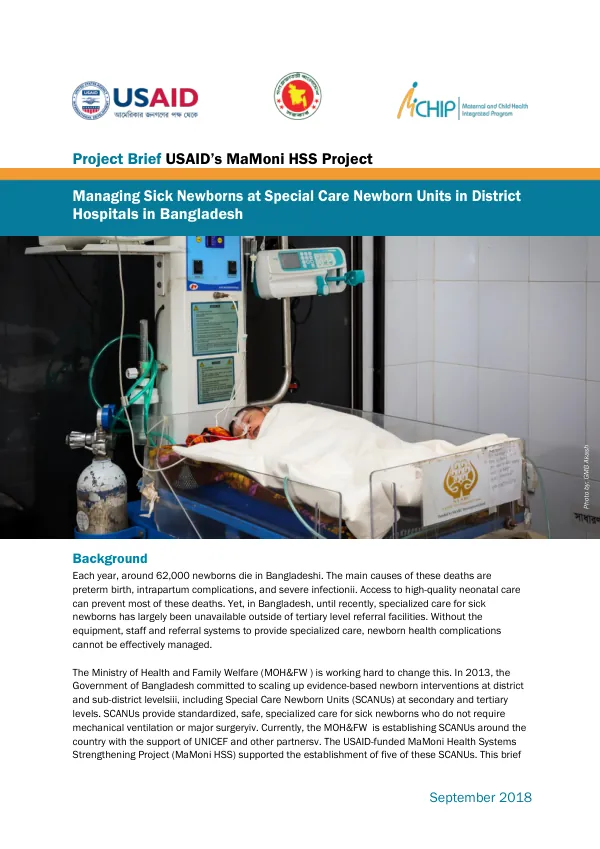
The project focused on establishing Special Care Newborn Units (SCANUs) at district hospitals to provide standardized, safe, and specialized care for sick newborns. The project supported the establishment of five SCANUs, including two in Noakhali and Lakshmipur districts, which were the focus of the analysis. The national framework for scaling up SCANUs was published in 2014, outlining the recommended services, space, equipment, staffing, and operational specifications for SCANUs. The standard operating procedures for SCANUs indicated that each unit should have four to five beds for every 1,000 annual births, staffed by at least two nurses and one pediatrician/neonatologist or trained medical officer. The staff were required to receive specialized training at a designated national training center. MaMoni HSS provided support to the Ministry of Health and Family Welfare (MOH&FW) in establishing the SCANUs, including equipment procurement, installation, and maintenance, as well as capacity building for the staff. The project funded the training of 102 nurses and 46 doctors at the designated training centers. The training included a 5-day Emergency Triage Assessment and Treatment (ETAT) and Sick Newborn Care training, as well as a month-long hands-on training for SCANU nurses. The project also facilitated quarterly routine supervision of each SCANU by neonatologists from national-level professional institutions. The supervision encompassed monitoring the quality of care provided, providing feedback, and on-the-job coaching. A checklist was used during each supervision visit, and an action plan was developed after each visit with recommendations for follow-up. The analysis of service data from the two SCANUs in Noakhali and Lakshmipur districts revealed notable differences in the profile of newborns admitted to the units. A total of 1,270 newborns were admitted during the period examined, with 771 (61%) admitted to the Noakhali SCANU and 499 (39%) admitted to the Lakshmipur SCANU. The majority of newborns were less than four days old, with 63% of newborns at the Noakhali SCANU admitted in their first three days of life compared to 53% at the Lakshmipur SCANU. The duration of stay for newborns also varied between the two SCANUs, with a higher proportion of newborns at the Noakhali SCANU staying for more than one week (41% versus 8% at the Lakshmipur SCANU). The place of birth also differed, with a greater proportion of newborns at the Noakhali SCANU born at a private facility (21% versus 11% at the Lakshmipur SCANU). The symptoms and diagnoses of admitted newborns were also documented, with multiple symptoms and diagnoses common. The most common symptoms included respiratory distress, jaundice, and sepsis. The diagnoses included pneumonia, sepsis, and congenital anomalies. The analysis of service data from the two SCANUs provided valuable insights into the profile of newborns admitted to the units, the duration of stay, and the symptoms and diagnoses of admitted newborns. The findings highlighted the need for continued support and capacity building for the staff to ensure the provision of high-quality care for sick newborns.