MINISTRY OF HEALTH AND CHILD WELFARE
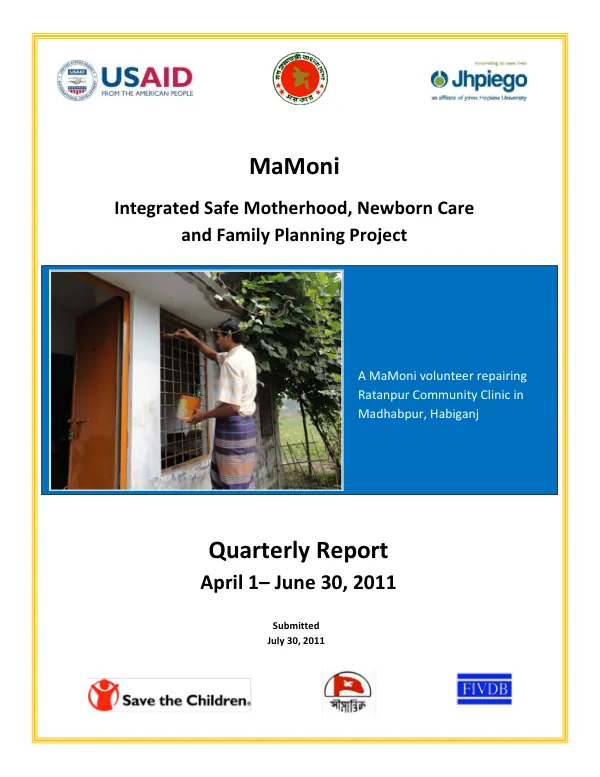
MaMoni Quarterly Report, April – June, 2011
The MaMoni Integrated Safe Motherhood, Newborn Care, and Family Planning Project is an associate award under the MCHIP program.
2011 · 28 pages
Sign in to readA free account is required to download.
Abstract
The project's key theme for the third quarter of the second year of operations is consolidating gains. The project rolled out key MNH-FP training activities in Sylhet and Habiganj to quickly cover all health service providers and rolled out key interventions on the ground. In Sylhet, 77 CHWs are now working in place of 68 vacant FWAs, and are supporting the FWVs at the satellite clinic and HAs in other MCH services. All CHWs have added misoprostol and FP in their household counseling visits. Results of misoprostol and FP distribution are further explained in objective 2 and 3 respectively. In Habiganj, government workers, mainly FWAs and HAs, are delivering the MaMoni package at the household level. As the data on Figure 1 shows, PNC visit in Habiganj has been less than ten percent. MaMoni has discussed this issue with the district and upazila level managers in the quarterly review meeting held on May 09. The GOB managers agreed to emphasize this activity. MaMoni is providing a number of temporary workers in key vacant units in Habiganj. Table 2 shows the breakdown of the temporary workers. MaMoni has received financial support from KOICA/Save the Children-Korea to provide 6 paramedics in Shibpasha and Kakailseo unions of Ajmiriganj upazila. All CHWs and all but four paramedics have been deployed and are providing critical outreach and MNH-FP services. The project's objective 1 is to increase knowledge, skills, and practices of healthy maternal and neonatal behaviors in the home. The MaMoni package delivered at the household level by community-based workers has been successful in increasing the knowledge and skills of the community members. The CHWs have been trained to provide counseling on misoprostol and FP, and have been distributing these services to the community members. The project's objective 2 is to increase appropriate and timely utilization of home and facility-based essential MNH and FP services. The MaMoni package has been successful in increasing the utilization of these services, with a significant increase in the number of PNC visits and FP services provided. The project's objective 3 is to increase acceptance of FP methods and advance understanding of FP as a preventive health intervention for mothers and newborns. The MaMoni package has been successful in increasing the acceptance of FP methods, with a significant increase in the number of FP services provided. The project's objective 4 is to improve key systems for effective service delivery, community mobilization, and advocacy. The MaMoni package has been successful in improving these systems, with a significant increase in the number of community members mobilized and advocating for MNH and FP services. The project's objective 5 is to mobilize community action, support, and demand for the practice of healthy MNH behaviors. The MaMoni package has been successful in mobilizing community action, support, and demand for these behaviors, with a significant increase in the number of community members practicing healthy MNH behaviors. The project's objective 6 is to increase key stakeholder leadership, commitment, and action for MNH approaches. The MaMoni package has been successful in increasing stakeholder leadership, commitment, and action for these approaches, with a significant increase in the number of stakeholders advocating for MNH and FP services. The project's overall challenges include the need to continue to consolidate gains and to address the issue of PNC visit in Habiganj. The project has discussed this issue with the district and upazila level managers and has received agreement to emphasize this activity. The project's key activities for the next quarter include continuing to provide training and support to CHWs and paramedics, and continuing to mobilize community action, support, and demand for MNH and FP services. The project will also continue to work with stakeholders to increase leadership, commitment, and action for MNH approaches. The project's operational plan indicators for the period of October 2010 to June 2011 are outlined in Annex 1. The project has received visitors to the project between April and June 2011, as outlined in Annex 2.