JHPIEGO
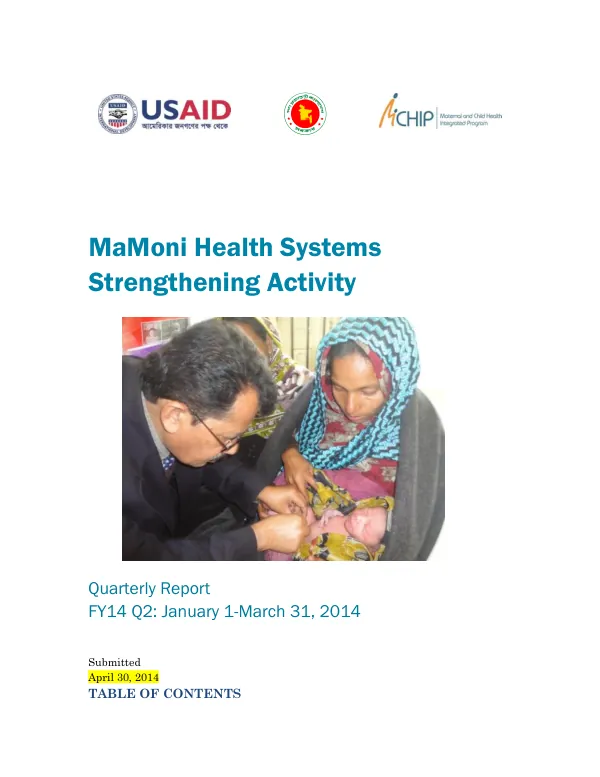
MaMoni Health Systems Strengthening Activity Quarterly Report FY14 Q2
MaMoni Health Systems Strengthening (MaMoni HSS) is a four-year Associate Award under the Maternal and Child Health Integrated Program (MCHIP), with a period of performance from September 24, 2013 to September 23, 2017.
2014 · 57 pages
Sign in to readA free account is required to download.
Abstract
The project focuses on strengthening the systems and standards for maternal, newborn and child health, family planning, and nutrition (MNCH/FP/N) in seven districts in Bangladesh. The project supports the Ministry of Health and Family Welfare (MOH&FW) to introduce and leverage support for scale-up of evidence-based practices already acknowledged in Bangladesh. The project is implemented by Jhpiego, with Save the Children (SC) as the local partner, in collaboration with John Snow, Inc. (JSI), Johns Hopkins University (JHU)/Institute of International Programs (IIP), icddr,b, Dnet, and Bangabandhu Sheikh Mujib Medical University (BSMMU). MaMoni HSS engages with local government structures and local NGOs to improve delivery of health services and strategically partners at the national level to build consensus around policies and standards that positively drive evidence-based interventions at all levels. The project supports the MOH&FW to strengthen the health systems in seven districts – Habiganj, Noakhali, Lakhsmipur, Bhola, Pirozepur, Jhalokathi, and Brahmanbaria. In addition, Sylhet district receives support during the first year of implementation for targeted newborn care interventions. Implementation in Brahmanbaria district is planned to start in the second year. Habiganj, Noakhali, and Lakhsmipur districts received substantial support under the previous MCHIP District Health System Strengthening (DHSS) program, and implementation will continue under MaMoni HSS. The goal of MaMoni HSS is to improve utilization of integrated MNCH/FP/N services and will be achieved through the project objective to increase availability and quality of high-impact interventions through strengthening district level local management and health systems. The project has four intermediate results: improved service readiness through critical gap management, strengthened health systems at district level and below, an enabling environment promoted to strengthen district-level health systems, and barriers to health service accessibility identified and reduced. The geographic focus of the project is on eight districts in Bangladesh: Sylhet, Habiganj, Noakhali, Lakhsmipur, Bhola, Jhalokathi, Pirozepur, and Brahmanbaria. The project is supported by a group of local nongovernmental organizations (NGOs) that are strategically placed in local communities, and are channels for scale-up and sustainability. Implementation of the project is ongoing, with a focus on strengthening the health systems in the target districts. The project has made significant progress in improving service readiness, strengthening health systems, and promoting an enabling environment to strengthen district-level health systems. However, challenges remain, including identifying and reducing barriers to accessing health services. The project has several key activities, including improving service readiness through critical gap management, strengthening health systems at district level and below, promoting an enabling environment to strengthen district-level health systems, and identifying and reducing barriers to accessing health services. The project also engages with local government structures and local NGOs to improve delivery of health services and strategically partners at the national level to build consensus around policies and standards that positively drive evidence-based interventions at all levels. The project has made significant progress in improving service readiness, strengthening health systems, and promoting an enabling environment to strengthen district-level health systems. The project has also identified and reduced barriers to accessing health services, including improving access to maternal and newborn care services. The project has also supported the MOH&FW to introduce and leverage support for scale-up of evidence-based practices already acknowledged in Bangladesh. The project has several key partners, including Save the Children (SC), John Snow, Inc. (JSI), Johns Hopkins University (JHU)/Institute of International Programs (IIP), icddr,b, Dnet, and Bangabandhu Sheikh Mujib Medical University (BSMMU). The project also engages with local government structures and local NGOs to improve delivery of health services and strategically partners at the national level to build consensus around policies and standards that positively drive evidence-based interventions at all levels.
Related documents